

Simon popped over a week or so ago – for some furniture building.
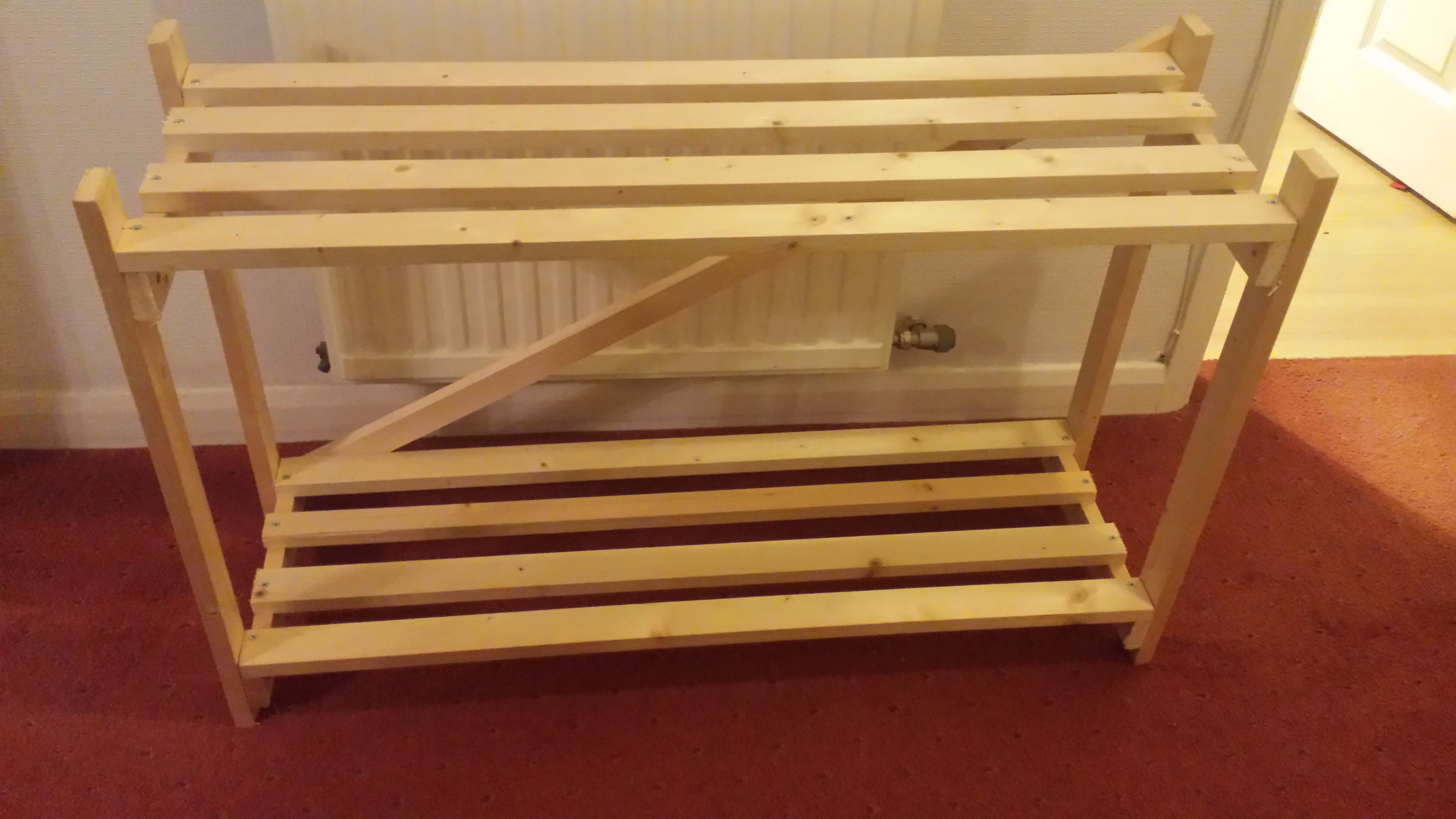
He and Kate decided that they needed some wooden shelving for wellies and walking boots, and since they had some spare lengths of timber around the house, as you do, there was clearly no necessity of bothering the Scandinavians in Ikea – instead Simon brought the timber to our house for some father and son bonding over a DIY project. And of course Chantal would be available if we got ourselves into a mess. On a dark and cold night we also have the advantage of a large warm and dry utility room.
We were well organised, and Simon drew an excellent three dimensional sketch, with all parts shown, considerably superior to Ikeas flat pack instructions, and we tweaked the design a little by adding bracing in the interest of rigid stability. We decided on the dimensions, and calculated how would make the best use of the three or four lengths of timber that were our raw materials. Simon even borrowed a pair of my wellies to ensure that the height between the bottom and top shelves was adequate.
The timbers were 2.1m in length, and we carefully measured and marked the length of each baton that would make up the slatted shelves. After cutting the first baton we meticulously used it as a measuring stick to ensure consistency of baton-length, and to make sure that what remained of the full length timber was sufficient for 1 leg of the structure, as previously calculated. It was at this point that we discovered that the 2.1m timber was in fact 2.0m, as confirmed by the label that still adhered to the timber, and a minor adjustment to the design was undertaken to ensure that we had sufficient wood.
Work continued apace, and we were impressed with ourselves as the shelving unit grew, looking most professional. Simon picked up the last piece of timber to cut the final baton for the top shelf, and then the bracing piece that would stretch diagonally across the back. It transpired that this length of timber was narrower that the others and the top shelf looked a little odd, with three wide strips and one narrow one. We hid the narrow strip on the bottom shelf, replacing a wider strip which was moved to the more visible top shelf.
We were very proud of the result, which was sturdy, functional, and, we felt, stylish and well designed.
We reckoned that an Ikea equivalent would have been £30, and would have entailed the trauma of a visit to the store. Simon subsequently helped to replace the door hinge on our fridge, a new one having been delivered after the door came away in Chantal’s hands a couple of weeks ago. Since Chantal’s first reaction was to purchase a new fridge/freezer, the overall saving for this evening of DIY was probably over £400. Bargain.
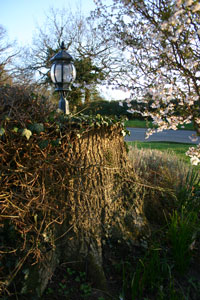 Technically we live in Oaktree House, but sadly the tree had to go.
We now have a thriving Oakstump at the front of the house.
Technically we live in Oaktree House, but sadly the tree had to go.
We now have a thriving Oakstump at the front of the house.