
DAY 8 – RETURN TO GLOVERSVILLE
We all met up in the Hotel dining room for breakfast. The hotel offered an optional Full American breakfast – it wasn’t actually called a “Full American” but it was certainly the American version of a Full English, and most of us took full advantage to set ourselves up for the day, before Alain took us to the airport for our return trip to Gloversville.
Our journey out of town was as navigationally challenging as entering town the previous day. The airport was not signposted. What sort of place has a secret airport? We did not have directions. Once again we were relying on the SatNav function on Leslie’s phone. We successfully found a motorway heading in the right direction – we could see planes landing off to our left, but as with motorways the world over, the highway stubbornly headed parallel to the flight paths. We took the next exit, but the SatNav instructions didn’t seem to match the street layout around us. It became apparent that the Satnav was totally correct give or take a block or two. This degree of precision is not an admirable quality for a SatNav. After a fraught half hour so, we were safely delivered to the airport, slightly later than planned but with time to spare, and had a somewhat rushed farewell with Alain and Rena.
There was quite a long queue through security, but we arrived at the gate with a few minutes to spare, only to find that the plane landed late, and was then delayed by a technical problem before we could board. From the number of passengers at the gate it was clear that our first flight, to Washington, was full, and passengers were requested to check in larger hand luggage, to travel in the hold, as space in the lockers would be at a premium. Chantal and I just had small backpacks. Leslie had a medium sized suitcase, and was determined to hang on to it. He was clearly experienced at this. He stayed hidden in the crowd at the back of the queue as staff were relieving passengers of larger items of luggage, but miraculously appeared at the front of the queue for boarding to ensure that he would find room in a locker. And he manoeuvred himself behind someone with a large case, and sneaked on board, as boarding staff were removing suitcase of the chap in front. There is no doubt about it – Les is a veteran traveller.
Thanks to the delay it was clear that we would be landing late, and in fact we had just ten minutes to find the gate and board the next flight to Albany. If we missed this there would be a wait of several hours for the next one. The stewardess reassured us that the departure gate was next to the arrival gate, about a minute away, and so we should be OK. Other connecting passengers were not so lucky – they had to catch a bus to another terminal.
The plane taxied in and started to turn left to the arrival gate and we could see the numbered departure gate just next door. No problem. Then the plane turned sharp right and headed for a gate in a separate “arm” of the airport building. From the on-board map of the airport, I realised that although the arrival and departure gates may still have been only a few hundred yards apart, logistically they were in separate terminals. Fortunately I had listened to the instructions for other passengers and knew that if we just followed the signs for our departure gate, we would leaving one terminal to enter another, and would have to go through security again. We would have to catch a bus to carry us across the few yards of tarmac between the terminals.
We found the queue for the bus, and boarded within a couple minutes, and the bus set off. And then stopped. The bus was not allowed to move without permission from the control tower. I wondered if the control tower was waiting for our flight to leave before allowing the bus to continue and take us to catch the flight that had just left. After five minutes we set off again, arrived at the adjacent terminal and ran to the departure gate, arriving just one minute before the scheduled take off time. We were ushered onto the walkway leading to the aircraft door, where this time Leslie was not so lucky – his suitcase was taken from him, to travel in the hold, before he was allowed on board. Chantal and I had to stuff our bags under the seat in front of us before the plane took off.
The rest of the trip proceeded without incident; we landed on time, and only had to wait a couple of minutes to reclaim Leslie’s case. It was a pleasant drive back to Gloversville in the afternoon sunshine which, at long last, highlighted the autumn colours of the trees along the route.
DAY 9 – VISITING FAMILY (AND THE DUMPSTER)
Wednesday dawned grey and damp and we had a “pottering” sort of day. Ruthie taught us how to play the card game that she plays weekly with friends. I can’t recall what it was called, but it was essentially a betting game, not dissimilar to poker, one of those games that take a while to understand, and then just as you get the hang of it, you realise that it takes years to be proficient. It was good fun. We must ask Ruthie to remind us of the name and how to play.
Leslie had a couple of business visits and then a chore to do – a visit to the dumpster, or “tip” as we would call it. Leslie lives outside of the City boundary, and so has no “garbage” collection, but instead has to take his rubbish to the Dumpster. People, who aren’t able to do so, maybe if elderly or infirm, pay someone to collect the household waste. Obviously we went with Leslie – after all how many tourists get a chance for this experience? The dumpster was smaller than you would find for an equivalent sized town in the UK, although I don’t know how many others were available in the vicinity. There seemed to be just two containers, one for household waste, and one for mixed recycling. No separation of materials for recycling, and only occasional spot checks of bagged waste to see what was being dumped.
On our return trip to home, we saw a house with no cladding – it was either being replaced, or cavity wall insulation was being installed. Houses in the U.S are commonly timber frames with an exterior cladding, initially of timber, then “aluminum” (aluminium) and nowadays PVC made to look like timber cladding. There are occasional houses apparently built of brick, but I suspect that the bricks were also just cladding of a timber framed building. When the outside of a house starts to deteriorate, the facade is just removed and replaced, and it seems that cavity wall insulation is installed by removing the cladding, inserting insulation, and replacing the PVC façade.
We had noticed that most houses (and businesses) in the U.S fly the Stars and Stripes outside, and many are also decorated with yellow ribbons, in support if troops serving in the armed forces abroad. Americans are very patriotic, at least on the surface. I don’t know why such fierce patriotism would feel uncomfortable in the UK – why do we only proudly fly the Union Jack during Royal celebrations? Why have we allowed football supporters to hijack the English flag of St George? Of course we were in Upstate New York, more Republican than Democratic, but nevertheless flying the flag, in every sense, is common in the U.S. Mind you, having been there during an election campaign, I can confirm that the average U.S. citizen is as likely to criticise the national Government, if not more so, as is the average Brit. Rest assured that “Yah-Boo Politics” is alive and well outside of the House of Commons.
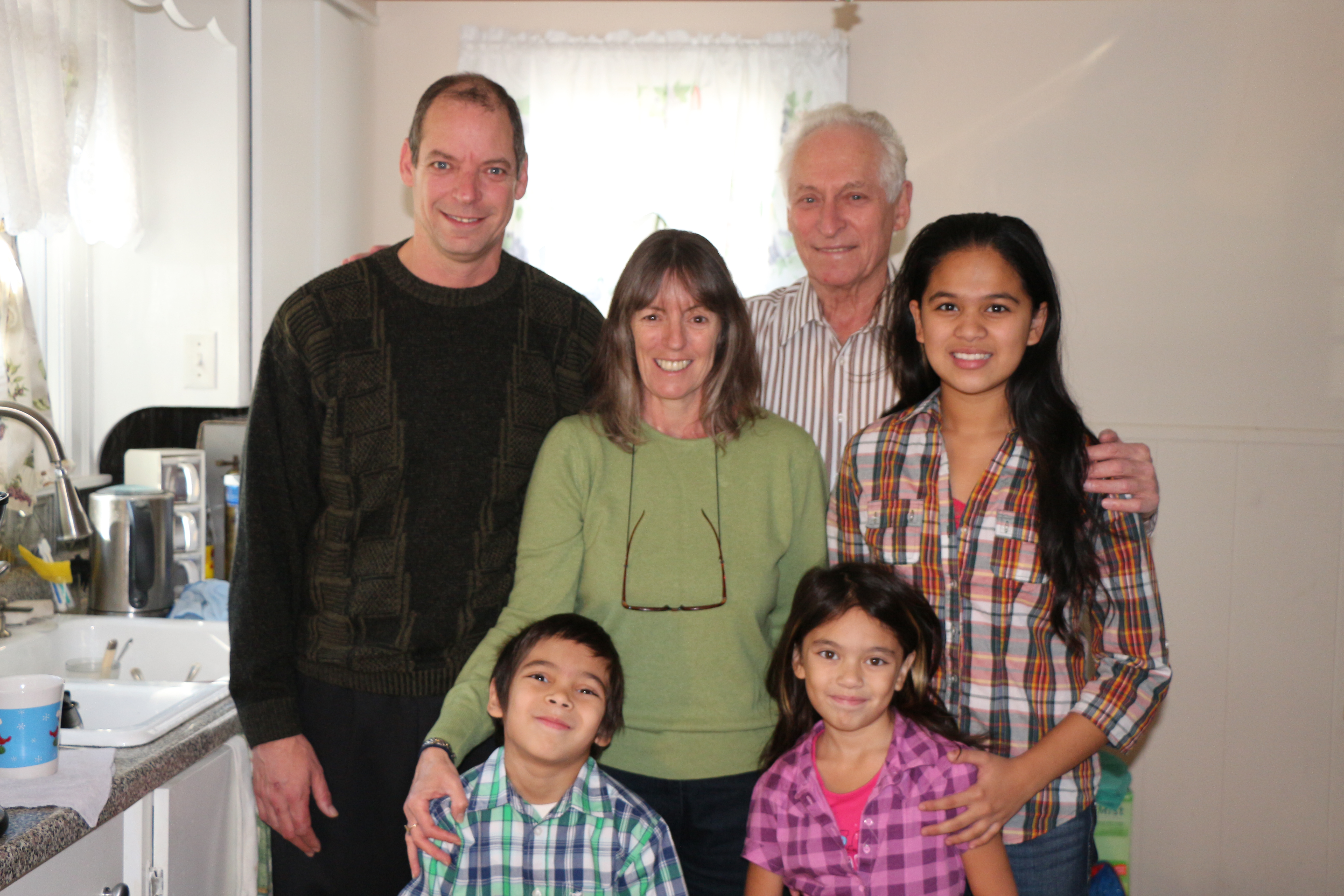
That afternoon we visited Duncan and family – Devin aged 6, Danika 8, and Monique 13. Ippany, who lives with Leslie, was also there, and Duncan’s wife Mylen arrived later. We had seen them all only briefly before we went to South Dakota, when we joined Leslie on the School Run. Ippany and Monique are dropped off at school at 7.45am, and “school is out” at 2.20pm. The younger children start school a little later, and so Duncan or Leslie, depending on whose turn it is, have a double school run each morning. The schools for the older and younger children are adjacent to each other, and seem more prepared for the parental school run than in the UK, with a car park immediately outside of the gate. There is a school bus service, but for some reason that escapes me, no doubt to do with distance from school, none of the children qualifies. The school buses are either the traditional dedicated yellow buses that are starting to make an appearance in the UK, or a taxi with a huge “School Bus” sign on the roof. In either case if one stops in front of you, you wait. Overtaking a stationary school bus is illegal.
We spent quite a while at Duncan’s home, chatting and catching up, and sharing photos. Ippany had borrowed a camera from school for a project that she was doing, and so there were even more photographers than usual. I reminisced – Leslie and Ruthie had lived here when we last visited the states, and I remembered the good times in the pool and on the veranda. It was distinctly hotter and drier than during this visit.
DAY 10 ADIRONDACKS
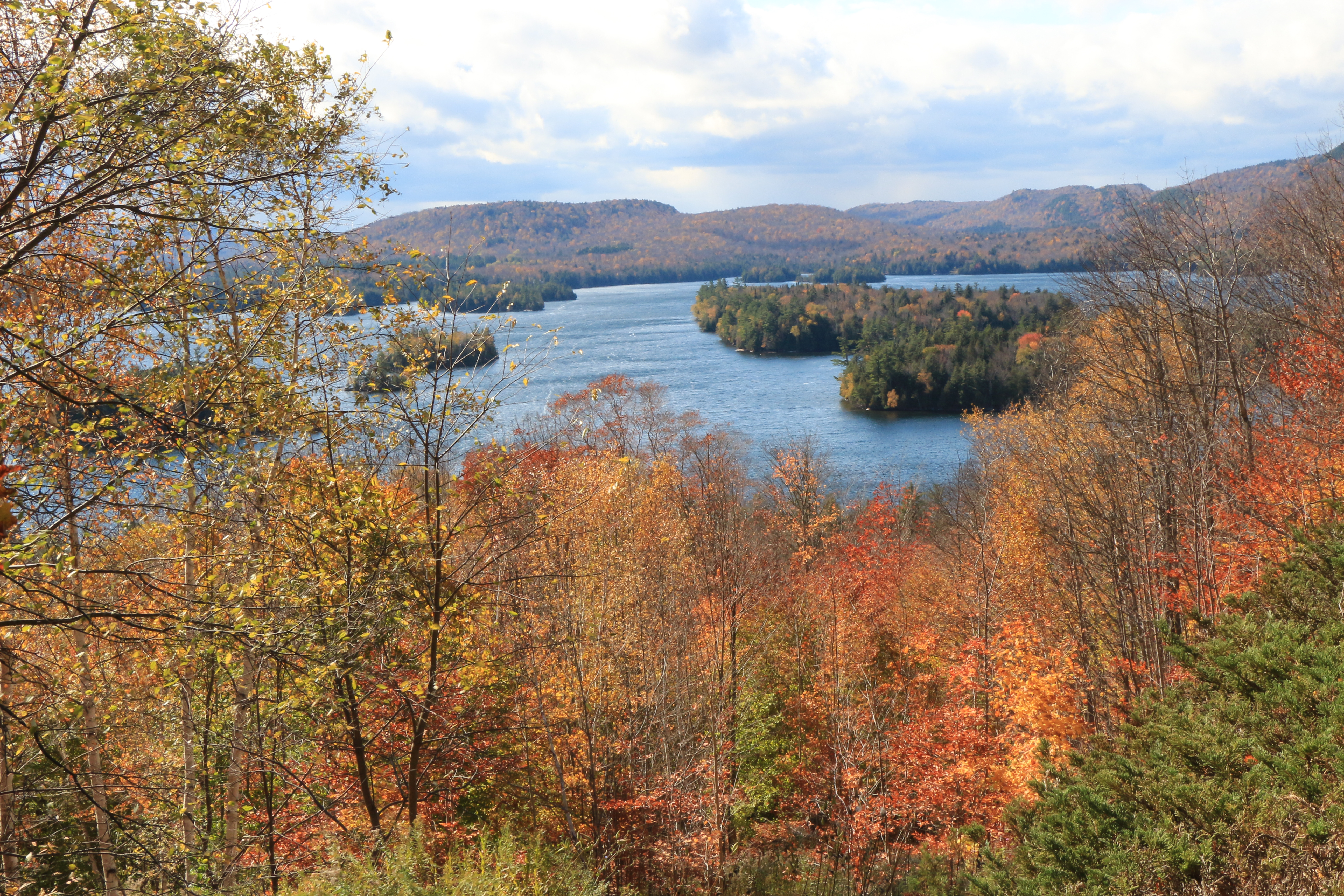
Another damp start to the day, although it had brightened up by midmorning, when we once again headed north into the southern Adirondacks. As we got into the hills the sun came out, and we had some magnificent views of the autumn tree colours with a backdrop of the higher peaks powdered with snow. We had no real plans, but ended up at the Adirondacks Museum, a large site with several buildings with displays of life, history and the natural history of the area. The site was in beautiful scenery, sandwiched between Blue Mountain and Blue Mountain Lake, with plenty of photo opportunities as we followed an audio trail between and inside the buildings. There was little about life in the area before white settlers, but plenty on how the settler’s had initially moved to the area to harvest timber. Most of the year was spent log cutting, but with no roads the logs stayed in situ until the frosts and snows of winter arrived, and they could be hauled to the river system on horse drawn sleds. They were then floated down river to the saw mills, each log marked to show the ownership of the timber.
The tourist trade opened when the railway link from New York was completed. The train took tourists to the edge of the mountains, from where it was a steam boat ride along the length of a lake followed by horse drawn carriages to basic but comfortable log cabin style hotels. The emphasis was on health and exercise, rather than luxury.
We went into an ice cabin, essentially a light weight shed that was slid out to the centre of a frozen lake, where a hole was drilled into the ice for fishing. We sat in an early bob sleigh. Winter sports are still a feature of the area, with skiing, but mostly, as I was told when I asked the café waitress what she did out of season, “snow shovelling”.
I managed to lose the others. Chantal and I ascended a fire tower but then couldn’t find Leslie, who had stayed on the ground. Chantal headed for the next exhibition, but I decided to find Leslie. I not only failed to find Leslie, I also lost Chantal, but I was quite content wandering around the exhibits at my own pace, and in peace, until I eventually came across them both, and we all went off to find lunch.
It began to rain again, making the already chilly wind seem colder and we decided that it was time to go home. We browsed the book and gift shop, where Chantal and Leslie told me that there was an entire exhibition that I had missed, and so I left the others browsing while I went to view it. It was considerably larger than I expected and by the time that I returned to the shop, the others had once again disappeared. I searched the site for some time, before locating them, and then they realised that they had actually only seen part of the large exhibition, and so I lost them once again. However with the rain getting heavier and the wind colder, we eventually met up, handed back our audio players, and headed for home.
Back at Leslie’s we stopped briefly before we popped for a quick shopping trip – quick because Leslie wanted to get back for some business calls. On our return Leslie’s door key would not unlock the door. Ruthie reported that she had also had trouble previously, a comment which Leslie didn’t find very helpful. However he was not concerned – they always left the patio door at the rear unlocked. Always, that is, except when a security conscious Chantal is visiting. Her last task, as she left the house, was to securely lock the patio door. As a responsible father, Leslie rarely swears in front of his daughter, but it came pretty close. However with a combination of frustration, panic, and vigorous manipulation of the key in the lock, Leslie managed to free the mechanism, and we were in. First job? Unlock the patio door.
DAY 11 RETAIL THERAPY
Typically the following day was a bright warm and sunny day, but nevertheless we wanted to stay local, since Ruthie was taking us to the auction that evening, and in any case we had an appointment with Junior. Junior runs one of the local diners, where Ruthie used to work, and we love it. This was our fourth visit, and Junior remembered us, since few tourists, and even less Brits, visit Gloversville. It is a wonderful atmosphere in the Diner – noisy, friendly, hot, and steamy, and we always feel at home there. It is the Gloversville equivalent of the Heathcote Arms, although I suspect that it may need more than four visits over fifteen years to feel a regular at the Heathcote. We had coffee, we ordered, we were served enormous breakfasts (I think that Junior had heard about the British recession and wanted to send us back having had at least one decent meal) and we chatted to Leslie and Ruthie’s friends – an excellent start to the day, but I wouldn’t be able to cope with it every day.
Afterwards Leslie dropped us off at Wal-Mart, and left us to shop. My requirements were simple – a box of biscuits or similar for work.
Chantal had fashion on her mind, and I found some sweatshirts that I quite liked, but since they failed the Chantal quality test, I had no choice but to wonder around the store, observing the differences between the American and British retail experience, starting with prices. On previous visits goods in the United States had generally been significantly cheaper than in the UK. This time goods were, if anything, slightly more expensive, although this was not really a survey of “day-to-day” purchases. Obviously I don’t know the price of day to day items in the UK. Wherever we had shopped in the States it had quickly become apparent that the shelf edge tickets excluded the sales tax, which can be a surprise at the checkout. There are two sales taxes – a State tax and a local tax, with total tax typically between 6 and 10% (but 14% in New York City). It makes having the right money at the checkout a challenge.
I first came across chip-and-pin for my credit card in the States ten years ago, when I didn’t have a PIN, and so had to sign for each purchase. On this trip no-one asked for my PIN. Not only was identification by a scribbled signature only, it was also common for the retailer to swipe my card, return it to me, and then ask me to sign, without checking against the signature on the card. The only exception was a shop in Deadwood where I bought a book, where they not only checked the signature, but demanded photo ID. I suppose that is what happens when you buy a book in a jewellery store.
In New York State (and I think in South Dakota) there is an over 21 rule for the purchase of alcohol, a little higher than the UK, but not dramatically so. However whereas in the UK we have a “25” scheme, where anyone looking under 25 must provide ID, in New York State they have a “40” scheme – anyone who looks under 40 must show ID to buy alcohol. For some reason I was never asked for ID. During our last visit to the States we had been asked for ID when buying a drink at a restaurant. In Boston even Leslie and Ruthie were asked for ID to our great amusement – it was a City rule that everyone must show proof of age. On this visit we were never asked for ID. We are obviously starting to look old.
Chantal was still browsing, and, if you’ll allow me some brief indelicacy, I felt an urgent need to check out the “restrooms”. I will not offend you with details, but as I exited the gents, another customer entered, sniffed the air and exclaimed a very loud “JEEEZUZ!” I beat a hasty retreat and was glad to find that Chantal was ready to head for the checkout.
We had a pleasant walk home in warm sunshine – just a couple of blocks, but enough for me to demonstrate my hopeless sense of direction, even on an American grid system.
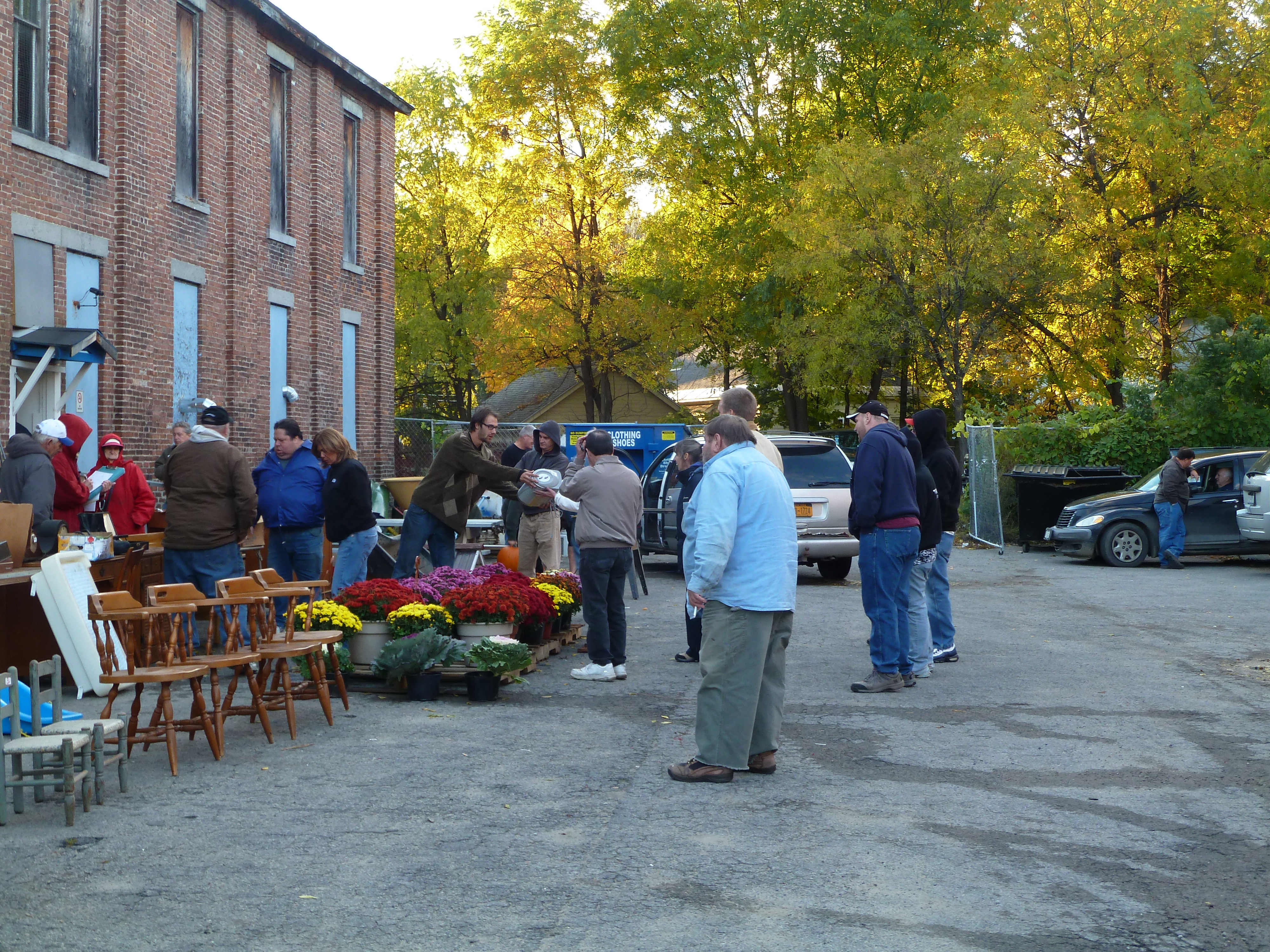
That evening Ruthie took us to the local auction. It was held in a warehouse, and we arrived early so that Ruthie could view the goods on offer, and we were introduced to the auctioneer, a large man who had known Ruthie for many years. The larger items of furniture were outside, together with a large quantity of pumpkins, and the auction started here – the auctioneer had the classic patter, almost unintelligible as he gradually disposed of the outside items before darkness fell, with the pumpkins sold first. When customers stopped buying individual pumpkins the final fourteen were sold as a job lot, although even then the price per pumpkin was higher than the price in the UK. Ruthie bought some flowers, and couple of items of furniture – those that I couldn’t fit in the car would be delivered tomorrow.
Then it was back inside for the main event. The auctioneer rattled through the items as his “assistants” carried them to the front to display. Most of the items were the sort of stuff you would probably see at a UK auction – furniture of various quality and condition, photo albums, machinery parts, electrical items, tools, books etc. And then there were the guns. There were about twenty shotguns and hunting rifles- all you needed to buy them was a driving licence to prove that you were over 18. In New York State you have to be 21 to purchase alcohol, but you can happily buy a shotgun at 18. At least, in theory, you won’t be drunk in charge of a hunting rifle. They all sold for between $100 and $200, about £60 to £120. Shotgun cartridges were also available at the auction, together with a gadget for stuffing gunpowder into shotgun cartridges, as well as clays, for those who fancied a pop at a few clay pigeons in the car park. There were hunting knives, sold individually and by the half dozen, some with blades almost a foot long. After the restrictions in the UK, I found it all most bizarre. The only small arms that cannot be openly purchased in the States is hand guns – as in the UK, handguns are severely controlled, and you certainly won’t find any at an auction.
Part way through the auction the auctioneer announced a welcome to we visitors from “across the big pond”. I’m sure that some people thought that he was referring to folk from the other side of the nearest lake. We left before the end of the auction – there was an awful lot still to sell, but it was getting late, and tomorrow we were off to the Big Apple.
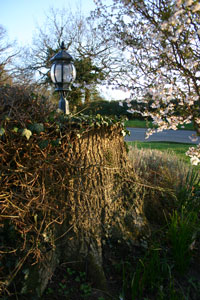 Technically we live in Oaktree House, but sadly the tree had to go.
We now have a thriving Oakstump at the front of the house.
Technically we live in Oaktree House, but sadly the tree had to go.
We now have a thriving Oakstump at the front of the house.