
NEW YORK AND SOUTH DAKOTA IN THE FALL (3) – THE BLACK HILLS
Coopers USA visit October 2012
DAY 5 MOUNT RUSHMORE AND CRAZY HORSE
We woke to a bright sunny day, with a sprinkling of snow. For a while Chantal and I had been keeping an eye on the weather in South Dakota, and watched the temperature vary between the low and high twenties centigrade. We had brought shorts to be prepared, and thought we may need to trip to Wal-Mart for a bottle of Factor 30. The numbers were about right, but not the letters – it was 20 F not C.
The hotel offered a “toast bar” which was exactly what it said on the tin – endless bread, lots of jams and spreads. It wasn’t the most exciting of breakfasts, but it served its purpose and we were soon on the road heading into the Black Hills. As we got higher the snow got deeper – not dramatic, but very pretty, or as Chantal and I would say, very photogenic. We passed a track down to a small lake and stopped for a winter walk. We stayed a while following the snow covered track down to the water, and of course talking lots of photos. Well, two of us did – the still clear water surrounded by snow covered trees was beautiful in this unexpected early taste of winter.
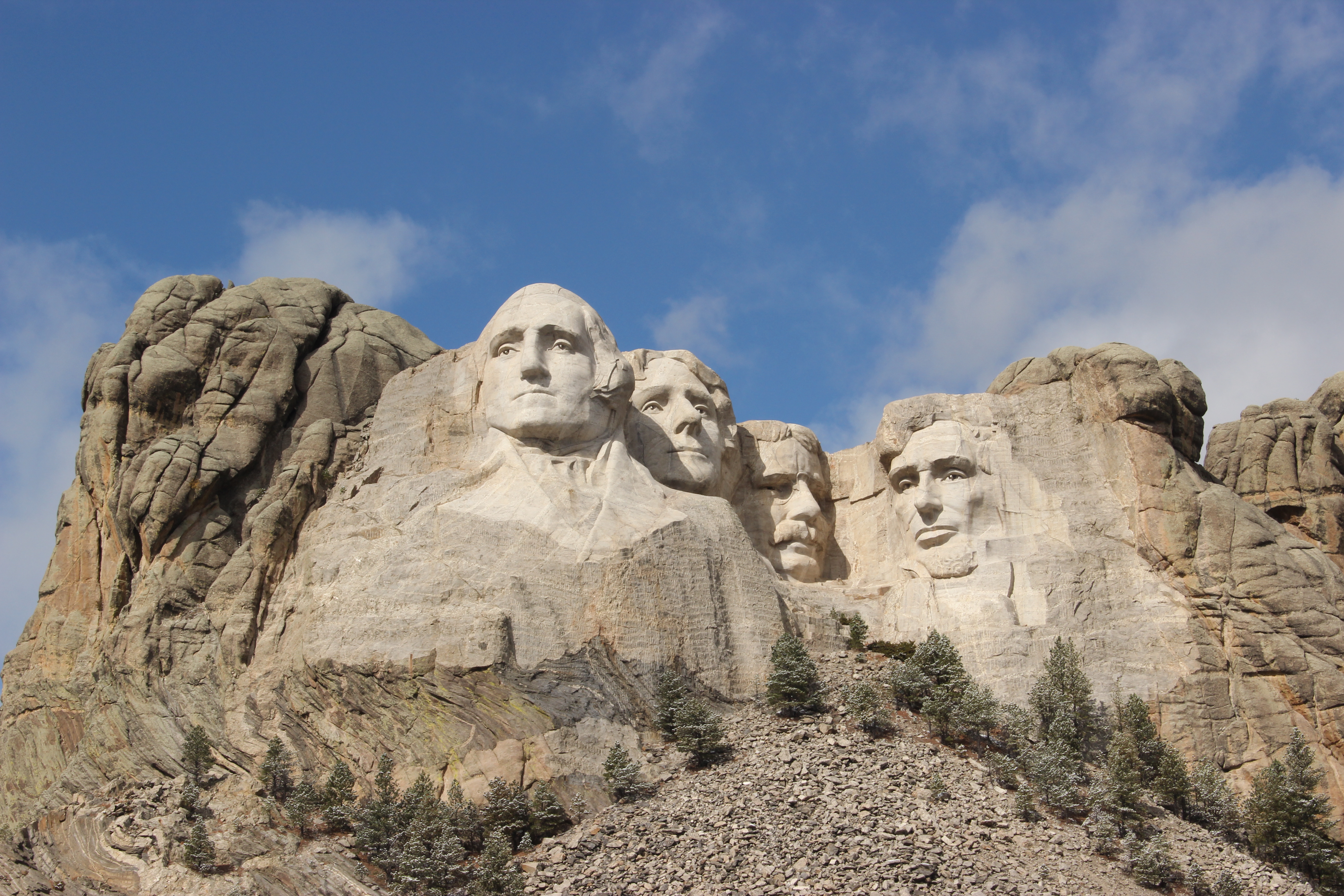
We continued to Mount Rushmore, the mountain with the 60-foot high sculptures, of four United States presidents: George Washington, Thomas Jefferson, Theodore Roosevelt and Abraham Lincoln. After parking we walked up steps to a large plaza, walking through an avenue of 50 flags, one for each state, with the sculptured faces high above us. Thanks to the weather, by now more cloud than sun, and a cold wind, this “National Memorial” was not particularly busy, and there was plenty of space to view the sculptures at the end of the plaza closest to the rock face. Naturally we took plenty of photos with the sculptured background – Les, Les and Alain, Les Alain and Rena, Alain and Rena, Les and Rena, Les and Chantal, Neil, Chantal, Neil and Chantal, the Father of the Bride, the Grooms family etc. etc. We took photos of the faces with surrounding rock, the faces with a surrounding sky, the faces with surrounding trees. And then the sun came out, and everything looked much prettier and so we took all of the photos again. I think that Alain felt that a roll of film with just 36 photographs was not such a bad thing after all.
As we walked back through the avenue of flags I noted that each had a plaque which stated when each State joined the Union to become part of the United States. The Union grew inland from the East and West coasts with the first States forming the Union in the 1780s, and the northern and central States joining later. I was surprised how recently some states joined the Union. It’s not surprising that Hawaii and Alaska, both recent “acquisitions” and neither part of the U.S. mainland, did not join until 1959, but I didnt realise that the Southern States of Arizona and New Mexico did not become part of the United States until 1912.
After leaving the Memorial, we stopped briefly for photos of the profile of the left hand President (I can’t remember which one that was) from a road-side viewing point before heading west and further up into the Black Hills, to the Crazy Horse Memorial, 6700 feet up in the Hills, where there was a foot of snow with heavy snow showers.
The Crazy Horse Memorial is the Native American answer to Mount Rushmore, a celebration of the great Native American leaders. Crazy Horse was a Chief of the Lakotas at a time when the Native Americans were being displaced from the plains and Black Hills by the incoming white settlers. The sculpture when finished will be of Crazy Horse, astride his horse, pointing to his lost lands over the head of the horse. It was started in 1948 when the Native Americans appointed a rock sculptor who had worked on the Mount Rushmore project. It will be a long time before the sculpture, being blasted from the rock, eventually to be 641 feet long and 563 feet high, will be completed – certainly not in my time. The Native Americans wish to remain independent of Federal funding, and it is likely to be over 100 years before the project is finished. At present only the 87 foot high face is complete, although a hole has been blasted to form the start of the space beneath Crazy Horse’s outstretched arm.
I much preferred Crazy Horse to Mount Rushmore. It had more atmosphere, making Mount Rushmore seem sterile. Maybe it is because it is an on-going project with a story. I could have spent much longer there, reading about the history and the construction work, but we still had a Powwow to go to, followed by the Deadwood Oktoberfest. We were certainly experiencing a range of cultures today.
Rena had spotted details of the powwow in a local paper the night before – probably the same paper that I was entertaining myself with in the casino. The powwow was taking place in a community centre in Rapid City, on the edge of the Black Hills. We found the location, a large civic building, and were directed to the powwow in a large hall, an ice hockey rink, with tiered seating . Although we had to buy tickets, this was no tourist event. A powwow is a Native American ceremony or meeting, which can refer to any gathering – in this case a dance and drumming competition.
When we entered several dozen Native American men were dancing in the “arena” to loud traditional music – drumming and singing. The perimeter of the “dance floor”, between the dancers and tiered seating, was full of groups of Native Americans, who, like the dancers, were dressed in full traditional dress, very bright, very colourful, and very intricate. There were people of all ages, from young children to elderly men and women. At the far end of the hall was a stage, where the organisers and announcer were seated. One or two judges, at least I assume that they were judges, were standing at the edge of the dance floor apparently making notes. The drumming and singing were coming from the floor-side groups, many of whom seemed to have four or five resident drummers – I think that some of the music was an amplified recording, although I was never sure whether the “live” drummers were accompanying the recording, or vice versa.
The male dancers were followed by a much smaller group of elderly women, who danced in a slightly more sedate fashion. This group were in turn followed by young children, and during the rest of the time that we were there, the competition was dominated by women and children, with just one or two smaller groups of men. I’ve never actually been to a dancing competition of any culture (I don’t think that watching Strictly Come Dancing counts). In some ways this event reminded me of the County Badminton competitions that I used to take the boys to, where it was not really a true spectator event – everyone had an interest in one or more of the players, and so were part of the whole event.
The tiered seating was almost full, and although we were not the only whites, we were definitely in a small minority. Many people were taking photographs from the side-lines, Rena had told us that this shouldn’t be a problem, and so we positioned ourselves close to the dance floor with a good view of the participants. There was an abundance of subjects on and off the floor, with the brightly coloured feathered costumes, as well as the action in the arena, and we snapped away happily..
After a while I began to feel a bit uncomfortable, and later Chantal said that she had felt the same. We both felt as though we were not particularly welcome, although neither of us was able to put a finger on the reason why. It was certainly not a joyful atmosphere, but since there was not a lot of laughter and smiles within the groups around the dance floor this could have been cultural (although during our last visit when we visited the reserve at Sioux Lookout in Canada, where Rena’s relatives live, we felt very welcome) or maybe it was simply because it was a competition being taken seriously by all participants. An alternative explanation was that we were taking too many obtrusive photographs, although I was conscious to avoid this at the time, and in fact took less than twenty photos in the hour-and-a-half that we were there. But then these were in addition those that Chantal took. Neither Leslie nor Alain noticed any “atmosphere”, and so maybe rather than being insensitive, we were just being over-sensitive, although we are both used to mixing with other cultures – in Leicester we mix socially and professionally with most of the Indian cultures and are quite relaxed on such occasions.
There is probably a whole thesis to be written, and indeed has probably already been written, on the inter-relationship between cultures in the context of who was there first, who was invited, who invited themselves, and who were forced to join in whether they wanted to or not. Both the United States and the United Kingdom are each perfect case studies.
We left the dancers dancing and the drummers drumming, and headed for the Hills – back across the snow covered Black Hills to Deadwood, to try to catch the last hour or so of the Oktoberfest. Alain had promised us German Oompah bands in the street, festive singing and frothy beer. Especially frothy beer. We were too late. The streets were quiet, and the only signs of the day’s activities were some straw bales and some signs in bar windows inviting people to pop in and fill their beer tankards – the prohibition on drinking in streets had been lifted for the weekend. We discovered that the bales had demarked the course of the Daschund racing – possibly something best avoided anyway. By all accounts the Deadwood Oktoberfest had been quite a low key affair compared to others that Alain and Rena had attended.
We did find some decent beer though, when we headed to a bar for something to eat. Samuel Adams is a Boston Brewer which produces some popular, but nevertheless dubious, American beers. Their marketing department did, however, persuade the brewers that brewing an Oktoberfest Beer would be a good plan. I don’t know whether they were trying in vain to produce a German style beer using American know-how, but the result was a beer too flat for Germans, too hoppy for Americans, and consequently quite acceptable for the British. Leslie and I enjoyed a pint or two, but Alain insisted on imbibing more of his favoured beer that needed the addition of fruit juice in the form of a slice of orange. I accompanied my beer with a burger. Americans may not always come up with the best steak these days, but they certainly do a mean burger.
Naturally after our meal we headed for a casino – this time a different, slightly smaller, one. It had the advantage of a good sized bar leading off the gaming area, and Chantal and I headed there. The choice of beer was once again restricted to those popular with the regulars, and so I joined Chantal in opting for a coffee, which, it turned out, was complementary. As with the burgers, Americans certainly do a mean coffee. We chatted for a while, but then Chantal felt the irresistible pull of the slot machines, and disappeared to join the others, leaving me on my own, with a newspaper, in an empty bar. Bliss, especially since the “barmaid” (I suspect that they are not referred to as “barmaids” in the States) kept my coffee cup filled. However the bar eventually filled up with a large group of women, and since they were gathered snugly around a couple of tables designed for two, whereas I was comfortably ensconced on my own at a table designed for at least eight, and the thought of the ladies joining me was quite terrifying, I went to go and find Chantal.
I decided that it was time to stop being miserable, and to have a flutter. Like the casino the previous evening most of the machines were available and so I settled down next to Chantal, fed the machine with a $10 bill and pressed spin. And then I pressed spin. And subsequently I pressed spin. Three minutes later my $10 dollars was used up. Apparently most folk take the trouble to watch the screen between spins, just to see if they have won, which strings out the whole process, whereas my instinct was to get the whole thing over with, having at least made the effort to join in. However thanks to the lack of alternative attractions in Deadwood, I decided to push the boat out and feed the machine with another $5. Spin. Spin. Spin. I won! I can’t remember how much, but it wasn’t worth wearing out my shoe leather by taking the winnings voucher, or whatever it is called, to the cashier. And so I opted to re-invest my winnings. Spin. Spin. Spin. These machines entice the punters into believing that they are onto a winning streak by teasing them with a prize of a few cents every now and then. Clearly the next spin will be the life changing one, and so it isn’t time to go home yet. In my case I just didn’t want to bother the cashier by cashing in the dollar equivalent of a 50p voucher, and so I kept on playing. Spin. Spin. Spin. My attempt to donate my $5 to the casino became a tedious process and I was relieved when the machine finally gave in, and accepted my donation without feeling the necessity of giving me some change.
I was quietly (well, maybe not quietly) watching Chantal on the adjacent machine when a lady sidled up to me from behind, and practically whispered into my ear “Has the train come in yet?” To say I was startled was an understatement. What exactly was “Has the train come in yet?” a euphemism for? Was this an invitation of some sort? Deadwood, as an old mining town, does have a reputation for certain pleasures other than gambling. Did she not realise that the lady next to me was my wife? I started blustering something about not being sure what she meant, when Chantal saw my expression and kept a straight face as she explained that these machines had a train theme (I hadn’t noticed) and announced a winning jackpot by emitting a train whistle. The lady was merely ascertaining the likelihood of leaving the establishment in a richer state than when she entered. I could have confidently enlightened her on this matter, but instead gave up my seat.
I was once again relieved when we called a taxi back to the hotel shortly afterwards.
DAY 6 DEADWOOD
A more relaxed day. Chantal and I had decided to spend the day exploring Deadwood, and the others also decided that this was a good plan. This gave us a chance to enjoy a good breakfast instead of toast and jam at the hotel. We piled into the people carrier and drove the short distance into Lead, eventually locating the interestingly named Spankies Café. All except one climbed out of the car chatting animatedly, and headed for the café. It had been my turn in the back seat. I waited for my wife to pull the middle seat forward to allow my exit. She didn’t. Instead she closed the rear door, chatting happily to Alain who pointed the car key over his shoulder as they crossed the road, and I heard the clunk as the doors locked. “Oy!” I shouted, but they all had breakfast on their mind, and apparently I hadn’t been missed. I hammered frantically on the window, and managed to attract their attention before they entered the café. I’m sure that Chantal would have apologised for trapping me in the car if she hadn’t been laughing so much.
We had a classic American breakfast, enjoying ham, eggs, sausages, pancakes, and French toast. Much as I enjoy maple syrup with pancakes, I really can’t get used to maple syrup with “powdered sugar” (or icing sugar as we call it) on French toast (“eggy bread” in our part of the world). As usual I got a bit confused over the correct order of words for ordering my eggs – was it “easy over” or “over easy”? and so I ended up ordering them as “upside down softy” which the café owner understood perfectly.
Over breakfast we discussed travel arrangements for the next day – our journey back across the prairies to Minneapolis. We agreed a 4.00am start would allow time to explore Minneapolis after checking in at our hotel.
We headed for Deadwood – first stop the cemetery. Well actually first stop was the dropping Rena off at the laundrette, since Rena and Alain were running out of clothes, but the second stop was the dead centre of Deadwood, to see the graves of Wild Bill Hickok and Calamity Jane. Bill was a chancer, arriving at the height of the gold rush in the 1870’s with the intention of relieving the prospectors of some of their hard earned gold. He was a card sharp, not surprisingly unpopular with those who lost to him, and consequently he always sat at a card table with his back to the wall. He was late for one game, ended up with his back to the door, and was shot in the back by a gentleman who felt that his losses to Bill hadn’t been entirely fair.
Jane was also a chancer, arriving in Deadwood disguised as a soldier, and becoming quite a character in the town, frequently drunk and disorderly, while at the same time spending time caring for and nursing prostitutes in the town. She had strong feelings for Bill who did not reciprocate. By all accounts Jane was a bit of a stalker. She died a year after Bill, and at her request was buried with him. Bill was not in a position to object.
We visited the cemetery visitor centre and gift shop, found a map, and headed up the hill to the graves. We quickly found those of Wild Bill and Calamity Jane and then had a walk around the frosty snow-sprinkled cemetery in the bright sunshine. It was in nice location, high up above the town, with pine trees amongst the graves, and panoramic views over Deadwood and the surrounding hills.
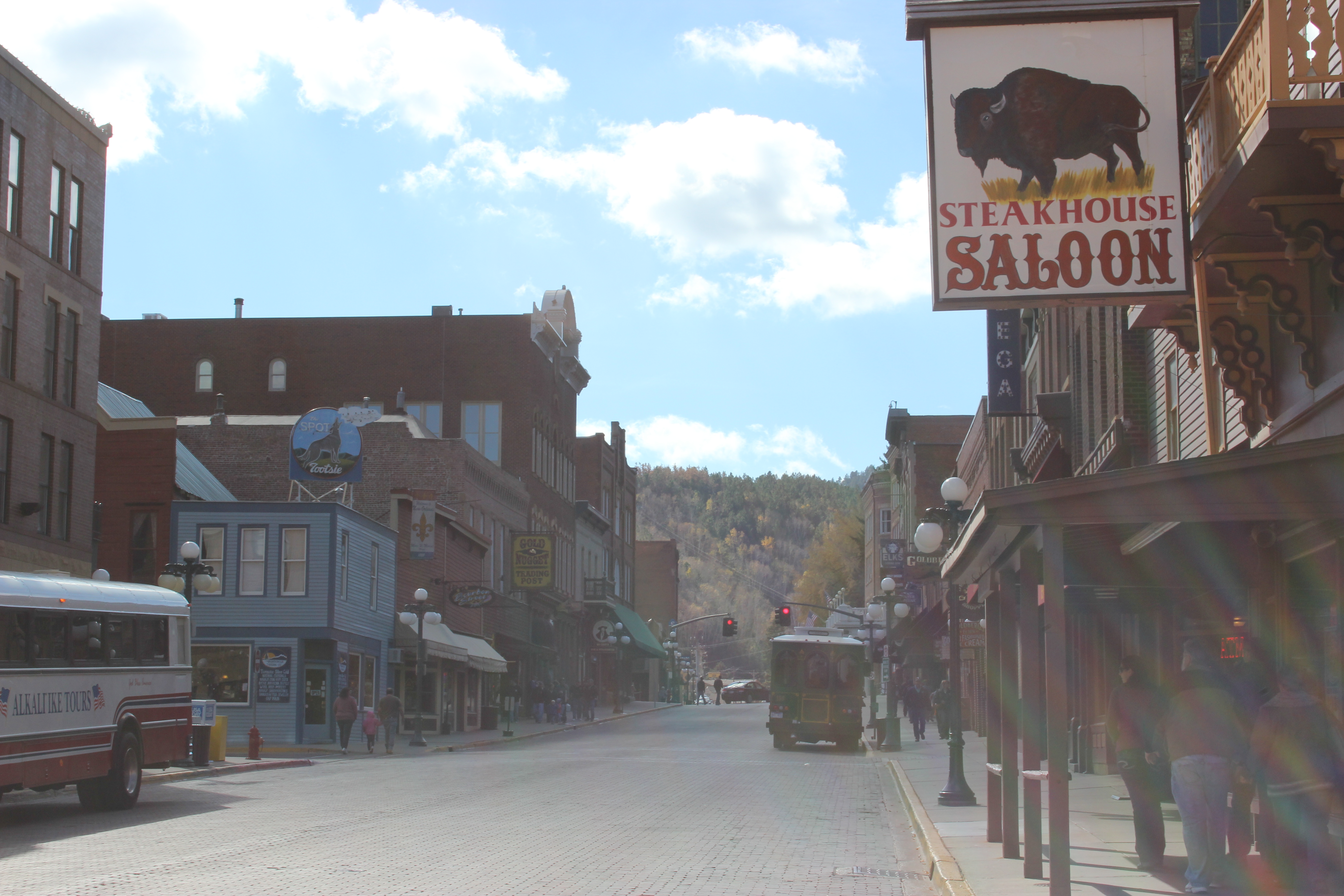
Alain returned having collected Rena from the Launderette, and dropped Chantal and me in Deadwood Main Street. Nowadays Deadwood is a smallish town with a population of about 3000. In the late 1870’s when gold was discovered in the hills around Deadwood, the town grew to 10,000 as it became a hub for the prospectors “claims”, which radiated out from the towns into the hills, following the valleys. A claim was a site registered by a prospector once he (always a man) had had dug trial pits and decided that there was the potential for gold. Each claim was 300 feet square, a legal specification, where the prospector dug for gold, built very basic gold processing equipment and established his accommodation, initially a tent, but eventually rough and ready timber buildings. Registration defined the location of the boundaries and the main instrument used to confirm the location of the boundary, and to enforce this in the case of adjacent claims, was the shotgun.
The expanding network of claims needed servicing. They needed food supplies, timber mills, hardware stores, engineering workshops, assayers to assess the quality of gold, banks and, of course, lawyers. Deadwood, at the foot of the Black Hills, became established to provide these needs, growing from a few tents and temporary structures to a large township of permanent substantial buildings within two to three years. Since most buildings were constructed of timber, and the surrounding Hills were prone to summer forest fires, the town burned down from time to time and so has been subject to a few reincarnations over the years.
A brief foray into gold mining, if I may – I found it fascinating. Gold is found in quartz. Quartz weathers over time, and rain and water run-off washes away the soil and fine rock particles, but the heavier gold remains in a bed of gravel on top of the bedrock, which may be just below the surface of the ground, or many feet deeper. Prospectors dig down to this gravel layer (which, of course, may contain no gold whatsoever), and transport it down to the river for panning – washing the gravel away to leave the tiny particles of gold. Regular readers will know that Chantal and I panned for gold in Australia, taking gravel from the bottom of a stream and swirling it around to reveal gold particles. It seems that gold isn’t really found in river bottoms, at least not in the Black Hills – the river is used to wash the gravel excavated from further up the side of the valley. Panning is very labour intensive and inefficient, and was soon replaced by wooden constructions of cascades and baffles over which the river water flowed, taking away the gravel and leaving the gold. As the potentially gold bearing gravel became exhausted, new technology replaced the simple washing process, allowing gold to be chemically removed from the underlying quartz bedrock. Gold had been discovered further west many years before, and the technology was established and available.
Gold was not the only earner; the claims themselves had value and were traded. Prospectors needed to be optimists, since generally several months of excavations may take place, sometimes up to two years, before gold, if any, was discovered on a claim. Not all prospectors stayed the course – their first Black Hills winter was a particular test. Many decided to cut their losses by selling the claim, maybe to the owner of an adjacent claim who still had faith in that particular location. As the gold bearing gravel became exhausted, extracting what remained became increasingly labour intensive, needing a financial investment, and claims were sold to partnerships or companies that could provide this. The value of the claim depended on the amount of gold in the bedrock. Rock samples were assayed, and certified to provide proof of this, but assayers could be “persuaded” to be a little generous in their estimation of the potential for gold extraction. A sensible buyer would visit the claim and take a sample to his own assayer. Before his visit a sensible seller would take a small amount of powdered rock, add a tiny amount of gold, and fire the mix from a shotgun into the bedrock that was to be sampled. If the buyer wanted gold, he would get gold,…
The lawyers were kept busy with contested claims. However, whether or not a prospector could prove that a claim was his, legally it wasn’t. Under Federal Law the entire Black Hills was a reserve that belonged to the Native Americans. White settlers were banned from entering the area. That didn’t seem to matter once gold had been discovered.
Back to 2012. We spent the rest of the day contentedly browsing. The commercial enterprises of Deadwood seemed to comprise 50% casinos/bars and 50% gift shops (we were unable to find a café when we fancied a coffee and cake), not normally a natural environment for me. However many shops had a display of books, and I love browsing books, eventually treating myself to two. The above gold mining information was derived from “Deadwood The Golden Years”, which I heartily commend to anyone remotely interested. I am currently reading “Bury My Heart At Wounded Knee”, the story of how the west from won, but from the perspective of the Native Americans, just as fascinating.
We had agreed to meet up with the others before finding somewhere to eat, but in fact came across them as we were exploring. We returned to the bar where we had eaten the previous day, and so Les and I enjoyed some more Oktoberfest beer with a snack. We further discussed our travel arrangement s for the next day – perhaps 4.00am was a bit ambitious. We would set off prompt at 5.00am.
Then it was time to head for the casino again – but not for me. I really had exhausted my enthusiasm for disposing of dollars by pressing a button, and so set off to further explore Deadwood, taking photographs for as long as the fading light would allow. I returned to the casino where the others were contently tapping the machines. They were clearly settled in for the evening, and so I asked the casino to call me a taxi, and I returned to the hotel. Before I left the casino there was another brief discussion about our travel arrangement s for the next day – perhaps 5.00am was a bit ambitious. We would set off at 6.00am and no later.
After packing I channel-hopped and found the non-commercial public broadcasting station, which, believe it or not, was showing Upstairs Downstairs. And so I sat in a hotel room in an historic mid-American gold mining town watching a very British historical drama, which was infinitely more exciting than repeatedly pressing a spin button on a gaming machine. Nevertheless I was pleased when Chantal joined me only a short time later.
DAY7 BACK ACROSS THE PRAIRIES TO MINNEAPOLIS
We set off at 6.00am as planned. Day 6 was spent much as Day 3, but heading east rather than west. We stopped at a McDonalds, where I had my first McDonalds breakfast, which was OK, but which I wouldn’t travel far for. Fortunately the toast bar at the hotel had been ready for guests before we left. Chantal was indecisive, but eventually chose a cinnamon Danish pastry. The lady serving her enthusiastically complemented her on her choice. – you would have thought she had chosen a fine wine.
We travelled, we refuelled, we travelled, we stopped for a break, and we travelled, the prairies continuing to every horizon.
At one refuelling stop we swapped drivers, Leslie taking over from Alain. Now there have been plenty of opportunities for Leslie to demonstrate that maybe I was no longer giving his daughter the care and attention that she deserved. A discrete word in my ear maybe, but he decided that action was better than words. He climbed into the driver’s seat, and we climbed in the back. Leslie, keen to continue the journey, promptly set off. I wasn’t on board yet, or at least not quite on board. As he set off to re-join the highway, I had one leg in the car and one leg in the fuel station. Fortunately he took note of my howls of protest as my right leg hopped frantically to keep pace with my left leg, which was bowling along at 10 mph without any effort whatsoever, and braked. The open sliding door had no brakes of it’s own, and continued in a forward motion, hitting me smartly on the left shoulder. Eventually everything came to rest, and was allowed to embark my entire body into the vehicle. I am still waiting for that discrete word.
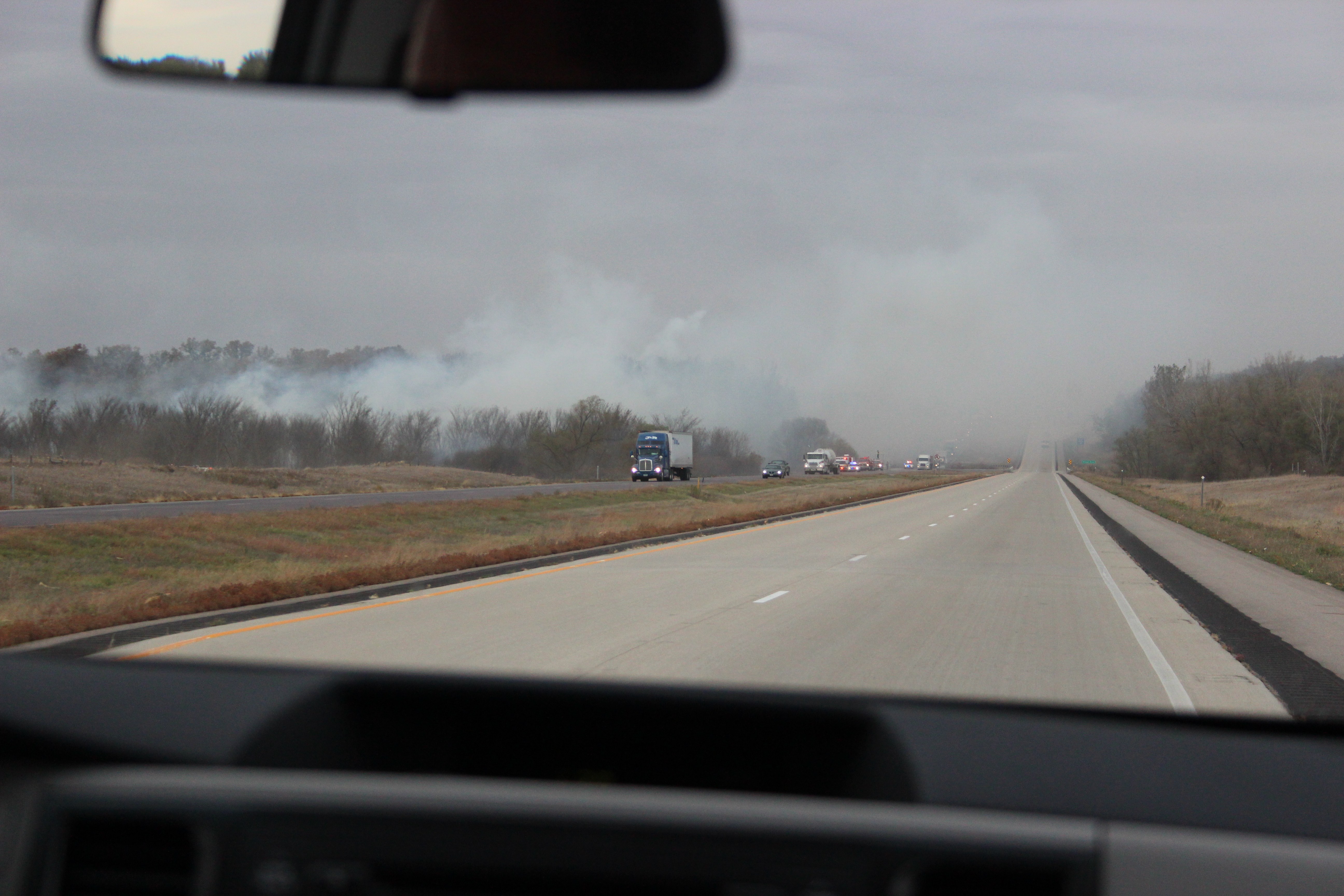
We passed a scrub fire, with thick smoke billowing across the road, luckily on the opposite side of the highway where the dense smoke was causing a tailback.
We listened to country music. We had got into the habit of listening to country music, listening out for the most heart-breaking of songs. Country music, by definition, must be sung by someone who had lost his wife/girlfriend/home/dog and who feels the need to end it all, and tell the world all about it. The favourite heard during the previous few days was a happy little ditty entitled “I Hate Everything”, although we also enjoyed a much more optimistic number, in which the singer invited his girlfriend to “Ride Up and Down On My Little Green Tractor”. That must be an invitation not heard much beyond the prairies. If it was green, maybe he should be keeping it to himself. When we finally lost the Country Music Channel I entertained, with a rousing rendition of The West Country Song. On the prairies they have a Big Green Tractor. In the British West Country they have a Thrashing Machine.
By early evening we approached Minneapolis. Alain could remember where the hotel was, but wasn’t sure how to get there. Chantal had a printout from the website with directions. Leslie had SatNav on his phone. Getting to the hotel should have been a doddle, but the web and SatNav instructions contradicted each other, and both differed from Alains’s memory from a previous visit. It had been a long day, Alain needed a nicotine fix, and things were getting fraught. Les in the very back seat shouts “Take the next Exit”. Neil in the middle seat shouts “Les says take the next exit” Chantal in the front seat says ““The instructions say carry on”. Alain says “I remember heading straight for the city centre” Leslie says “Why didn’t you take the exit”. Neil says “The instructions say carry on”. You get the picture.
We find ourselves in the dense road system of the city centre. Alain can see where he needs to get to, but has to follow a one way system and get in the correct lane in the busy traffic. Chantal is finding it difficult to locate where we are on her instructions. This is an ideal scenario for the urgent and immediate assistance of SatNav. “What does the SatNav tell us to do?” asks Alain. “I don’t know” says Leslie. “You were all ignoring it, so I turned it off”
We eventually located the hotel, and Alain dropped us off before parking the car. We had booked a 4 star hotel, and the foyer was huge and plush. The rooms were a good size and definitely plush, but we didn’t stop to admire them for long – we headed for The Brits, a pub/restaurant with, as you would expect, a British Theme. Alain and I enjoyed an excellent pint or two of Old Speckled Hen (Alain wouldn’t have been able to get his orange fortified lager here) and Leslie didn’t enjoy a rather dodgy fizzy pint of Bass, after which he followed the example set by Alain and me. We all enjoyed fish and chips – British food, but an American portion. We staggered back to the hotel well and truly satiated.
It had been a wonderful few days. We had travelled across Prairies, Badlands, Black Hills and now a metropolis. We had seen the cultures of modern American large scale farming, historical and modern Native Americans, white settlers, gold miners, and now the British culture. Well, sort of.
See “Rushmore, Crazy Horse and Deadwood” in “Our Recent Photos” – just over two pages of images.
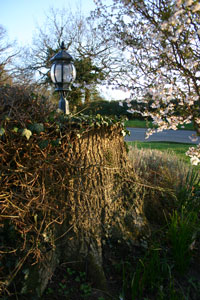 Technically we live in Oaktree House, but sadly the tree had to go.
We now have a thriving Oakstump at the front of the house.
Technically we live in Oaktree House, but sadly the tree had to go.
We now have a thriving Oakstump at the front of the house.