
NEW YORK AND SOUTH DAKOTA IN THE FALL (2) – PRAIRIES AND BADLANDS
Coopers USA visit October 2012
DAY 3 PRAIRIES
We had an early start, leaving Gloversville at about 3.00am to travel to Albany, about an hour away, for a 5.30am flight to Minneapolis. We were chatting quietly as we drove along the highway through the misty darkness when my olfactory senses were suddenly assaulted by a horrendous stench. It certainly wasn’t me, and felt it unlikely to be Les or Chantal. “Skunk!” announced Leslie – we hadn’t run over it, merely given it a fright as it approached the road. It was a combination of stagnant water and rotting flesh – the nearest that I have smelled before was when one of our dogs rolled in a badger that had clearly been dead for many weeks. The smell cleared through the car after a few minutes, but seemed to remain embedded in my nostrils for hours.
We arrived in plenty of time for our flight, initially to Washington, where we were to catch a connecting flight to Minneapolis. The flight was uneventful, but was obviously a “domestic” flight since Chantal and I had a minor domestic as I opted to switch on my reading light so that I could read my Kindle, whereas Chantal required total darkness in an attempt to sleep. I retired hurt to a spare seat next to Leslie, a few rows behind us.
As we landed in Washington DC, Chantal and I were both convinced that the landing time, announced as we descended, was an hour earlier than the time displayed on our watches. We had obviously entered another time zone, which meant that we only had 15 minutes before boarding the next flight. Leslie, a local, was not so sure of this, but was outnumbered 2 to 1, and so we ran breathlessly to the allocated gate for the Minneapolis flight, pausing only briefly for a rushed “comfort break”. The seats at the gate were deserted, as was the departure desk. We could not see a clock. Washington DC appears to be the only airport without clocks. Even the information screens are timeless. Maybe it is to prevent terrorists from synchronising watches. I eventually found a discreet clock in a corner and discovered that we hadn’t, after all, crossed a time line. As Les pointed out, we had flown almost due south. With a bonus hour to spare, we went and found breakfast.
Alain and Rena, Chantal’s brother and partner, were there to meet us at Minneapolis airport, having driven down from Canada the previous day. It was good to see them again. We were introduced to the hire vehicle for our trip – a luxurious eight seat minibus. We would be doing a lot of travelling and at least we would all be comfortable, and everyone could have a window seat. We navigated out of Minneapolis and headed across the prairies for the Badlands.
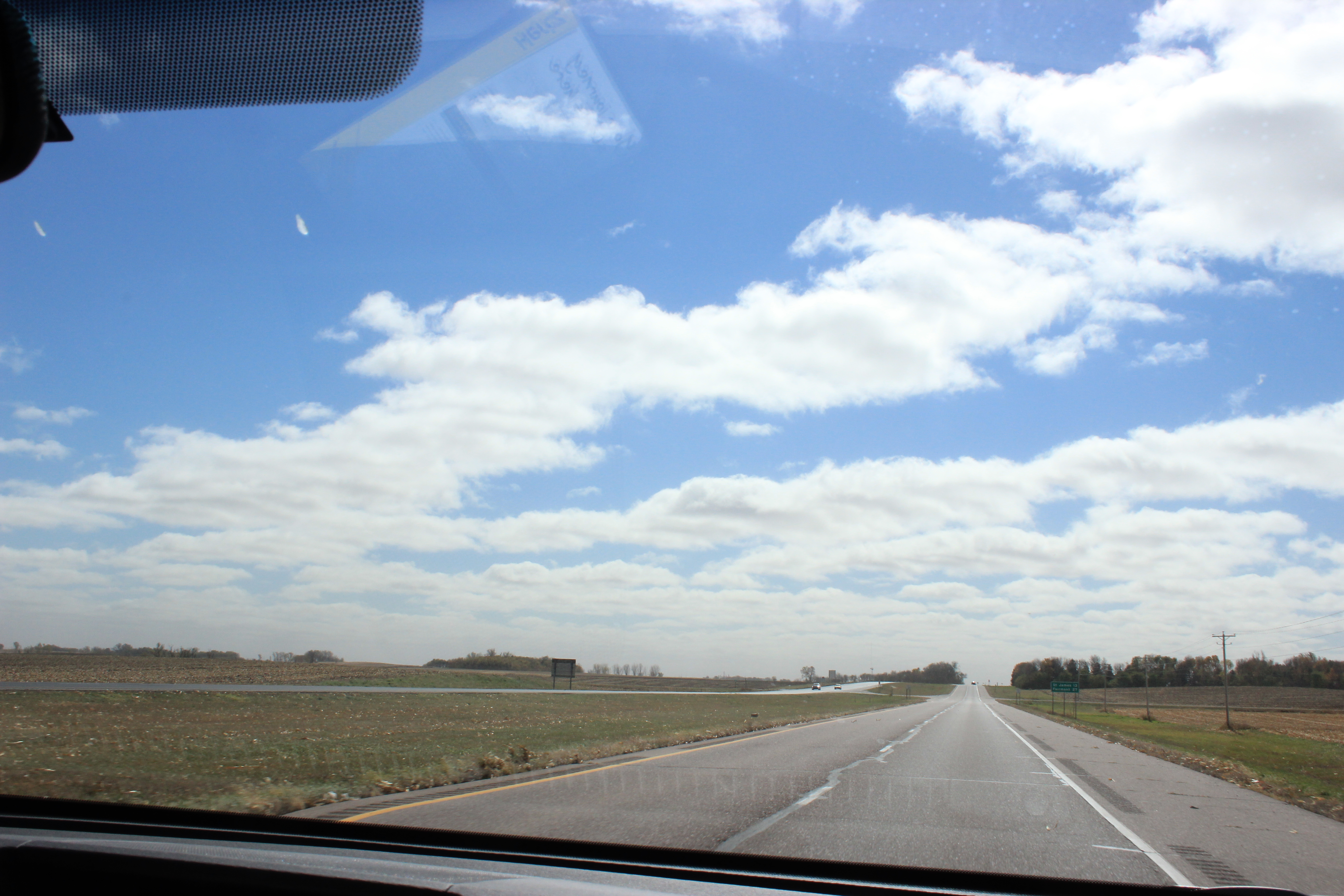
America is big. Australia was (and presumably still is) bigger, but in Oz we flew everywhere, and so it was difficult to grasp the concept of the distances involved. We drove 650 miles across the prairies, which is the equivalent of a continuous drive from Plymouth to Inverness, with the scenery barely changing. Ok, there were slight undulations for the first few miles, but then Interstate 90 just headed west through flat grasslands, some planted with cereals, some harvested, some ploughed, but all stretching to the horizon in every direction.
No wonder the Americans consider the UK to be like a theme park. In 650 miles we passed little of interest to the average tourist, apart from a palace built from corn, a few miles from the highway, which we passed without investigating. How many attractions and places of interest are there within a few miles of the route from Plymouth to Inverness?
Every now and then Alain, who was driving, announced to Chantal and me that the scenery was well worth photographing and that therefore he would oblige us by stopping immediately. The scenery had not changed for the last two to three hours and the scenery was unlikely to change for the next two to three hours. Nevertheless Alain felt that the scenery should be photographed, and must be photographed just here and right now. An experienced statistician would have quickly appreciated the clear relationship between Alains’s appreciation of the surrounding views and the level of nicotine in his blood.
There were a few small towns visible from the highway, but otherwise the vista was only broken up by farms with massive grain silos, some with a huge mountain of grain – it was not clear whether this was destined for a silo, or truck or railway waggon. A railroad followed our route for much of the way, sometimes adjacent to the highway, sometimes up to a mile or so away We stopped occasionally at “service stations” that we came across, generally restricted to a couple of fuel pumps, and a small diner. We chatted to the lady serving in one of these. She lived in a small town close by, which even by UK standards would be a small village, with no bar, no shops, and just a small school for the youngest children. It did, however, boast three churches. Most working people commuted – I can’t remember how far, but it was quite a distance. Agriculture, mostly mechanised, was not a major employer in the area.
Naturally we came across McDonalds. Whatever your view of such corporate franchises, at least the food and service is predictable and adequate, and when all that is desired is transient grazing they do meet the requirement. For this reason I have taken advantage of McDonalds in Stockholm, as well as beside Sydney Harbour, and McDonalds served our purposes for one of the personal refuelling stops in American Prairies. There was language barrier. The staff spoke English, and we spoke English but the difference in accents created a bit of a language barrier between Chantal and the lady taking the order. The folk on the prairie clearly had limited exposure to a Leicester accent. Chantal eventually made herself understood by speaking slowly and clearly, although there was still a lack of comprehension about what Chantal was asking for. Why would anyone dine at a McDonalds and ask for water?
Chantal had a “Must See” check list, which included, somewhere near the top, buffalo. Periodically, as we progressed across the prairies, Alain would shout “buffalo!” or sometimes the Native American term “Tatonka”. Inevitably, as Alain knew perfectly well, they were Aberdeen Angus cattle. Consequently we were somewhat sceptical when he shouted “Buffalo” somewhere vaguely in the area of Sioux Falls, but nevertheless on our left was about a dozen farmed buffalo in a large field behind a fence. We turned off the highway, and located some buildings associated with the buffalo – a grocery/tourist shop on a smallholding which specialised in buffalo products. We browsed briefly, but our only purchase, by Alain, was a pack of Buffalo Jerky, dried and cured buffalo meat. Chantal managed to offend the proprietor, in front of the only other customers, a couple from the Netherlands, by announcing “In the UK we give this stuff to the dogs”. I have never seen buffalo Jerky in Pet City – we actually give beef jerky to dogs, which is no doubt from an old dairy cow with meat unsuited for human consumption. Nevertheless, after Chantal’s remark, the Dutch couple were not tempted to sample this snack.
We had made no definite plans for an overnight stay. We eventually reached the banks of the wide Missouri River, almost a mile across at this point, and crossed the bridge to the outskirts of the town of Chamberlain, with a population of about 2500 and a choice of hotels. We still had 154 miles, over two hours, with an hour or so of daylight left, before we reached Wall, the southern “Gateway” to the Badlands. Chamberlain was an obvious option for an overnight stay. We stopped for a coffee, and Alain decided that we would carry on to Wall, which would allow an early start in the Badlands the following morning. We continued westwards, and with the big prairie sky turned every shade of blue as dusk descended, the landscape around us began to change, with low hills appearing, and eventually the silhouettes of distant rocky outcrops in the distance against the darkening horizon.
We reached Wall at about 8pm, and found a choice of hotels at the edge of the town next to the highway. We selected the Days Inn. From the illuminated signs outside each hotel it seemed to have some advantage that the others didn’t have, or maybe the others had a slight disadvantage – I can’t recall. For $58, about £36, the hotel provided a Bedroom with a King for us, and $68 dollars provided Alain, Rena and Leslie with a room complete with a couple of Queens, which must have kept them happy all night.
It is generally known that Americans are at the larger end of the world spectrum of body sizes. In fact some may, quite disparagingly, consider that they have a tendency to obesity. For Brits travelling in the States this has advantages. The average British King size bed is 5 feet wide. The American equivalent is 16 inches wider. An extra 16 inches may not sound a lot, but during our stay in American hotels we could sleep together or apart as we chose, whilst still sharing the same duvet. Popping over to the other side for a cuddle took some planning. And, maybe more importantly, the bedrooms were proportionately bigger. We always had plenty of space to move around without getting in each other’s way (although, obviously, Chantal would have said that I was the one getting in her way).
Having settled in, which, for a one night stay, took about a minute, we headed off into down town Wall for something to eat. The hotel receptionist told us that the centre of town, with a choice of restaurants, was a couple of blocks away. We found a bar/restaurant, which, since it was after Labor Day, had reverted to the off-season character of being mostly a bar, but which was nevertheless very friendly, with a good choice on the menu. The chap behind the bar, who served us, clearly knew the menu well, and competently answered all of Chantal’s many questions about each dish. The food was good, the company was good, and, brace yourselves, even the beer was good. Leslie and I found a very acceptable Irish Red Bitter, almost an ale. Alain found some rather anaemic looking lagery stuff, which he fortified with addition of a slice of fresh orange. Strange.
DAY 4 BADLANDS
The hotel offered a reasonable buffet breakfast. I tried a waffle, suitable laced with maple syrup, and decided that it tasted like the sort of packaging used to protect fragile items. I then realised, by observing another guest, that I should have toasted it, so I selected another waffle and fed it through then toaster. This resulted in a slight improvement – now it tasted like the cardboard box surrounding the packaging. After this early breakfast we packed, checked out and headed for the Badlands.
Most Brits will find it an anomaly to be charged to enter a National Park, but this is the case in the United States, although since a $15 vehicle fee provides access to 243000 acres for seven days, it is hardly extortionate. Mind you, if we had remembered to hand over the driving seat to Rena, there would have been no charge- First Nation people are given free access. I’m not whether this applies to all National Parks, or just in this case, since the area is a traditional hunting ground for Native Americans.
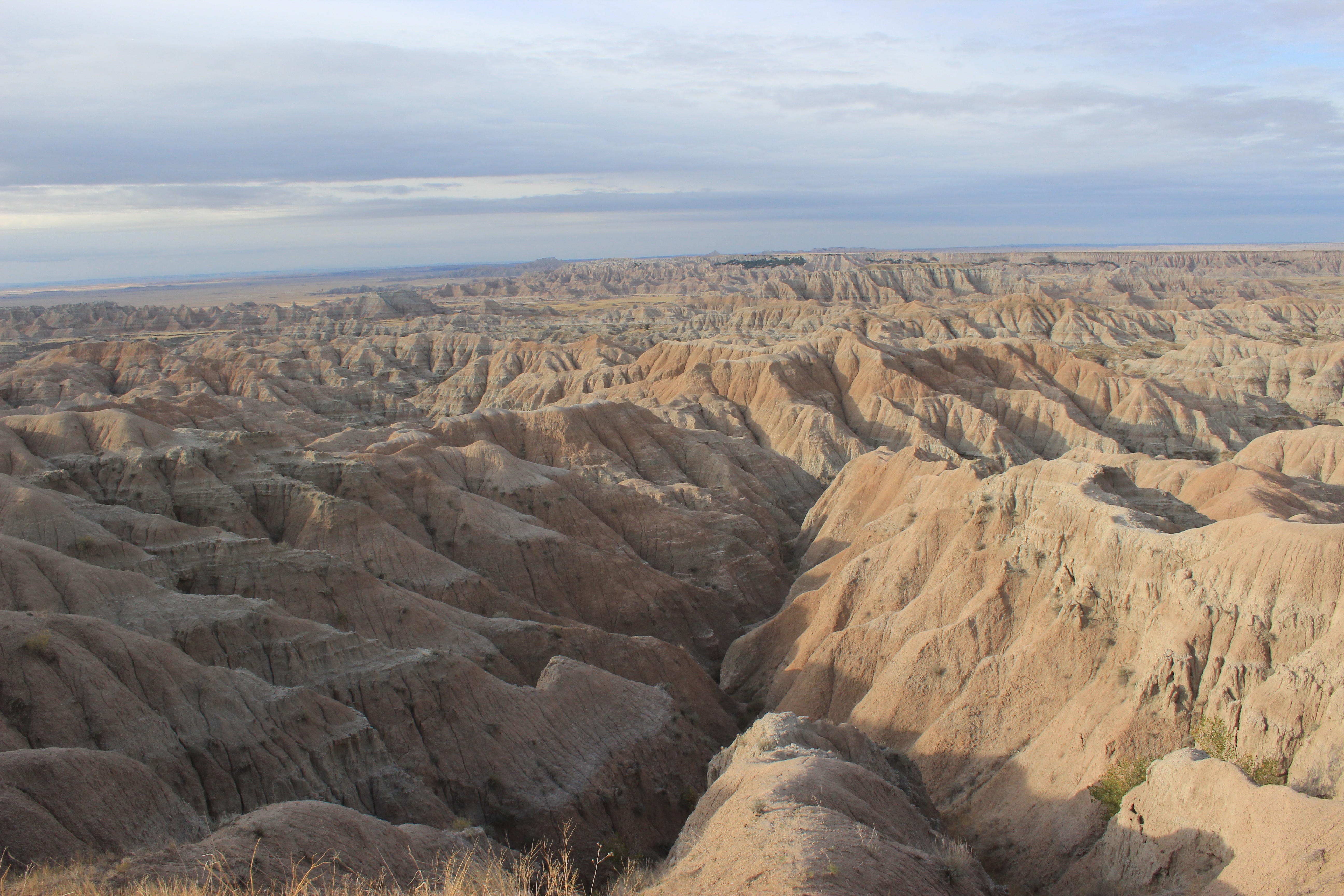
After leaving the entrance barrier, we entered the park, and soon turned off the surfaced highway onto a gravel road. Chantal felt that the farmed buffalo, seen alongside Interstate 90, didn’t quite justify a tick against “Seen Buffalo” on her check list, and Alain, who had visited the park before, knew that buffalo were often found along this route away from the main tourist loop road. Initially there was brown scrubby grassland to either side of the road, but then the view opened out. Below us, stretching for miles was a vista of deep gullies, separated by striated rock formations, two to three hundred feet high. The tops of the formations were below where we stood, and the view was like a lunar landscape. Horizontal coloured stripes traversed the rock faces, the stripes continuing from formation to formation, in the same colour and spacing, so that, although the rock formations were weathered and separated by the gullies, the striations continued across the landscape. It may or may not be unique, but I have never seen anything quite like it on this scale.
We didn’t find buffalo, but we did find several Bighorn Sheep with their characteristic large curved horns. We were able to get quite close to the sheep, and noted that that the ram had a collar with what was presumably a tracking device. The native bighorn sheep of the Badlands were hunted to extinction in the early 20th century, and now there are just three herds in the Park, about 350 sheep, and they are carefully managed.
We headed back to the main highway, and descended into the landscape of rock and gullies. The formations now towered above us, and coloured striations were accompanied by faces with all shades of red, orange, brown and yellow. Incongruously there were road works in the middle of this fantastic alien landscape of rocks. We were led convoy-style (just our vehicle) past a small group of men in high visibility jackets, apparently replacing the roadside kerb stones. It wasn’t clear why this stretch of road needed kerbstones, when the road edges generally sort of merged with the surrounding rocks without a clear boundary. One theory suggested in our party was that the working party was, in fact, a chain gang from the local County Jail. Or maybe this downhill stretch just needed measures to control water runoff from the surrounding rocks.
The road meandered through the rocks, descending all of the time. Our wildlife count was climbing rapidly. Prairie Dogs, standing up on the hind legs to peruse the surrounding area for threats, were as common as rabbits are in the UK at dusk or dawn. At one point the prairie dogs seemed particularly agitated, and someone (it wasn’t me) spotted what we though must be a fox in the distance. Rena dug out her binoculars, and announced that it was a wolf. We all took turn with the binoculars, and it certainly seemed wolf-like to me. I see many urban foxes while working at night, and it wasn’t a fox. Far too big, and the gait was wrong. Sadly it was too far away to photograph. Deer were quite common, crossing the road in front of us. To Chantal’s disappointment we did not see a rattlesnake, despite warning signs and advice from Alain and Rina to keep an eye on where we were walking. It was too cold apparently – despite bright sunshine (mostly) there was a cold wind. All sensible rattlesnakes would be snug in their burrows,
Before the road started to climb again we reached the Park visitor centre, an opportunity to learn, and enjoy a coffee, but mostly to shop. I asked about a short walk that I wanted to try. My guidebook described the “Notch Trail” as moderate to strenuous, 1.5 miles long and should take two hours to complete. 1.5 miles? Good grief – that is not even a short dog walk, even if it is moderately steep. I asked the visitor centre staff for advice, and they not only confirmed that it would take two hours, but that I should take plenty of water, even in this cool weather, and ensure I wore “suitable clothing”. Since I was the only one in our party who wanted a moderate to strenuous walk, and it wasn’t fair for the others to wait two hours in a visitor centre, I asked about the 3/4 mile “Door Trail”. The first 1/4 mile is on a boardwalk, but then the most foolhardy and adventurous can continue across the naked rock. Once again I was told to take care and be prepared.
We found the Door Trail, and headed off along the boardwalk. It was good to get away from the road, and after only a few yards we seemed to have left most of the other tourists. At the end of the boardwalk steps descended down to the rocks. Chantal, Alain and I decided we were feeling adventurous, and stepped onto a surface that looked like a pavement of mud riven with shallow gullies, two to three meters deep and one to two meters wide. The “mud” was in fact solid rock, and we could see the “Door”, a round open topped hole in a low wall of rock, in the near distance. But how to navigate across the gullies that unpredictably blocked our path, apparently in all directions? Easy. Just follow the bright yellow numbered posts.
It was an interesting stroll across the lunarscape, with plenty of photo opportunities, and it was peaceful. We may only have been a short distance from the road, but, with a bit of imagination, you could get a feel for the wilderness. Provided, that is, that you didn’t turn around and see the steps up to the boardwalk which remained visible for most of the trail. If this was a trail that required care and preparation, I felt that I could probably have managed the Notch Trail while the others enjoyed a cup of coffee, but time was pressing, and we still had Tatonka to find.
The staff at the visitor centre confirmed that buffalo could be found on the gravel road that we had taken after first entering the park. We just hadn’t driven far enough. This time we continued for about seven miles and sure enough came across four or five buffalo close to the road, with others visible in the distance. Chantal and I got cautiously out of the car, cameras at the ready. Chantal took a lot of photos – her long lens was a real advantage. I only had a “standard” lens, and so had to get closer to the buffalo for a well composed shot. I still wasn’t satisfied, and got a little closer. A big bugger, probably the bull, stood up and started to amble towards the three females – an opportunity for an action shot! I then realised that I was being summonsed back to the car, and there was a distinct sense of urgency in the summons – “Neil! Get back in here now!” So I did, and was reminded of what I had already read, and promptly forgotten. A bull buffalo can weigh a tonne, gets easily upset, and do 0-40 mph a lot quicker than I can. And I had also carefully shut the car door behind me as I got out, thus cutting off my means of retreat., I do recall Alain’s urgent please to return to the vehicle, but I don’t remember Chantal’s, who had already retreated to the car. I suspect she was watching the action through the viewfinder of her camera.
We returned to Wall where we headed for Wall Drug. In 1931 a newly qualified pharmacist decided to open a drug store in the small town of Wall to take advantage of passing trade travelling to Rapid City, over 50 miles to the west. The passing trade just kept on passing, and so the pharmacist put up signs for miles along the highway advertising free drinking water. Trade stopped passing, stopping instead, and engaged in a bit of retail therapy after having a drink of water. Wall Drug prospered and is now a small shopping mall with souvenir and craft shops, displays of historic photos, and a large restaurant. We first visited the restaurant where we all enjoyed a hot beef sandwich with large pieces of braised beef in thick slices of bread accompanied by potato and gravy. I wish that was common in the UK.
Chantal and I browsed the shops briefly, but were much more interested in the historic photos. Much of what is now the United States was colonised, or from the Native American point of view invaded, in the 19th century, coinciding with the rapid development of the technology of photography. Consequently this large display of photographs showed scenes of early settlers, homesteads, developing towns, Native settlements that had existed before the arrival of the settlers, and an apparent mutual relationship between Natives and settlers. From the photographs it all seems very amicable. History tells a different story.
There was still a drug store, and Chantal purchased ear plugs and melatonin tablets – she needs all the sleeping aids she can get, and had left both her ear plugs and melatonin in Gloversville. Incidentally Wall Drug still advertises itself extensively along the highway – for hundreds of miles between Minneapolis and Wall we were passing roadside hoardings detailing the delights of Wall Drug.
From Wall it was time to head for the Black Hills, but we had time for a brief visit to the Minuteman Missile, a few miles from Wall. In the 1960’s there were 150 of these scattered across South Dakota, managed from three control centres. The missiles were designed to be launched within six minutes during the Cold War, with the idea that if the Russians launched first at least the United States would have the satisfaction of knowing that Russia would be annihilated within a few minutes of North America. No doubt the rest of the Northern Hemisphere would reap the consequences over the following few months. How civilised. The chain of missiles was no secret – the U.S. government wanted the Russians to know the consequences of a first strike. The missile, now, obviously, disarmed, was a very low key affair – a small fenced compound just off Interstate 90, enclosing a glass “lid” over an 80 feet deep pit or “silo” containing the missile, with just a couple of information boards. The main site of interest is the visitor centre located in one of the nearby launch control facilities, but unfortunately it was getting late, and so we headed north.
Initially the main highway skirted the edge of the Black Hills, but we eventually the road started to climb as we headed towards Lead where we were staying for the next three nights. The pine covered hills became progressively higher on either side of the road, and we saw great swathes of bare soil where trees seem to have been felled. We initially assumed that this was a forestry operation, but later discovered that this was the result of Pine Beetle larvae that are clearly decimating areas of natural forest. At present, although the resulting scars across a mountainside are ugly, the affected areas seem limited. As we climber further it began to snow, and there was a visible dusting of snow on either side of the road.
We reached Lead, found our hotel, and booked in. Alain was keen to head into Deadwood, 3 miles to the north, to find a restaurant and so we arranged to meet in the foyer just a few minutes later. Chantal decided that there was just time to photograph the falling snow, illuminated by the lights of the hotel car park, through the hotel room window. We drew back the curtains to find that an outer insect mesh obscured the view. We slid back the window, and a blast of icy air entered the room, but at least we could move the mesh out of the way. A quick tug and the mesh screen promptly jumped out of its frame and jammed in the runners for the sliding window. We were now unable to close the window, it was several degrees below zero outside, windy and snowing, and we still couldn’t get a photograph.
By now the room was cooling rapidly, and we were approaching the agreed meeting time with Alain Rena and Les. I had visions of the steam from our morning shower meeting the cold air from the window, resulting in several inches of snow on the bed. I am always dubious about being over enthusiastic with anything remotely mechanical – things tend to get broken. I was in favour of calling the hotel handyman. Chantal is made of more robust stuff. With the prospect of a night in an arctic bedroom she gave a sharp shove to the mesh, which fortunately did not descend two storeys to the car park, but instead fell back into the window frame, and we were able to close the window.
We all took a taxi to Deadwood and headed for a restaurant in one of the many casinos in the town, and enjoyed a beer while waiting for a table. Well Alain enjoyed his beer – more of the fizzy stuff with a slice of orange, but mine was not particularly memorable. We had quite a reasonable steak with a bottle of excellent red wine all accompanied by a disturbingly enthusiastic waitress.
After dinner we went downstairs to the casino. Do not think card tables and roulette wheels with punters in smart suits. Think amusement arcade in Skegness, but on a very grand scale. There was a roulette table and an opportunity for blackjack, but most of the floor space was taken up by 350 slot machines. Now I have no problem with other people enjoying themselves on slot machines, but on the whole I would rather buy a tin a Dulux, apply it to a plank and watch it dry. For the un-initiated gambling on slot machines involves feeding dollars into the machine, and pressing the spin button. That’s it. Nothing else. And since the dollars will have purchased several spins you press the button again. And again. And again. Get the picture? Of course true aficionados will be watching the screen to see if they have won, while at the same time watching other machines to spot the players who walk away just as their machine is about to produce a jackpot, in which case a quick-step across the casino can, in theory, be profitable.
Chantal enjoys playing the machines, and on previous occasions I have also enjoyed such gambling evenings. In Niagara, while Chantal was repeatedly hitting a spin button, I watched the Falls, enjoying the roar and spray, and taking photographs of the floodlit water. In Grand Portage, close to the Canadian border, I watched the dusk fall over Lake Superior and then listened to frogs and watched the flashing fluorescence of glow worms.
Deadwood is somewhat lacking in natural charms. Before our holiday Chantal had assured me that she had no intention of playing the machines. She probably didn’t at the time, but she was seduced by the flashing lights and mechanical music, and so lost her to the machines. I sat next to her and read a newspaper and I admit that I got very grumpy. I got even more grumpy when, with 300 available machines (the place was quiet – it was after Labor Day) a woman wanted the one where I was seated, the only available one next to Chantal. I wasn’t sure whether casino etiquette allowed me to tell her that I needed the machine to lean my newspaper on, and so I moved across the room.
Fortunately it had been a long day for all of us, and so, to my relief, a taxi was summonsed reasonably early, and we returned through the snow flurries to the hotel.
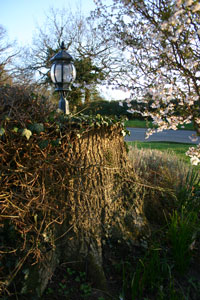 Technically we live in Oaktree House, but sadly the tree had to go.
We now have a thriving Oakstump at the front of the house.
Technically we live in Oaktree House, but sadly the tree had to go.
We now have a thriving Oakstump at the front of the house.