
Day 1 – Arriving.
Another early start, arriving at Cairns airport, Queensland, after a three and a half hour flight from Melbourne. Travelling part way up the east coast of Australia had taken considerably longer than flying from Luton to Zurich, demonstrating just how big Australia is.
Walking out of the arrivals area into the airport was like walking into a warm steamy bathroom or swimming pool, although with no visible steam. It was sunny, and hot and humid. It was time to put on the kangaroo hat. We collected the hire car and headed north on Captain Cooke Highway to Port Douglas, stopping for a meal at a small bar opposite a beach. Afterwards we crossed the road to the beach, golden sands, blue sea, but deserted. A sign explained why – beware of crocodiles and beware of jelly fish. There was a bottle of vinegar to treat jelly fish stings, but there was nothing to treat crocodile bites. Swimming was possible, but only in a netted off area, but we didn’t even paddle because we had no towels. With hindsight we should have done, because it turned out to be the only opportunity for a relaxed swim from a beach.
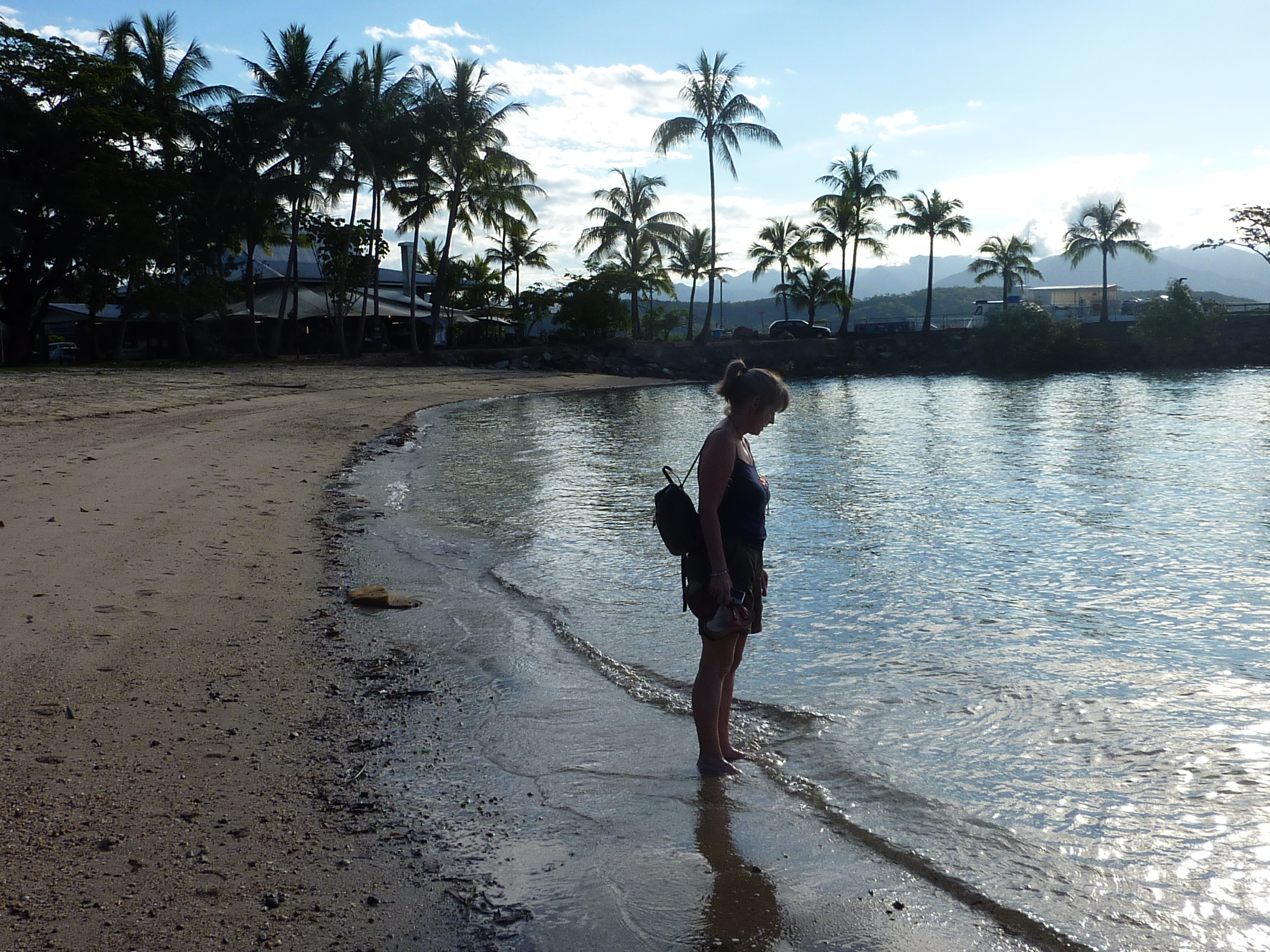
We carried on driving along a gorgeous coast road, with more golden beaches, fringed with palm trees on our right, and rain forest covered hills rising up on our left. We arrived at Port Douglas, and checked in at our apartment. It was perfect – fully air conditioned, with a large living room with kitchen area, large bedroom and bathroom, and patio area separated from a swimming pool by a screen of exotic plants. We set off to walk around Port Douglas, which proved to be a mistake. We didn’t realise quite how draining the heat and humidity could be until you got used to it, even in the early evening. We found a small beach, and Chas had a paddle just behind a sign warning folk to stay away from the waters edge, as crocodiles were a hazard in the area. I wasn’t worried – Chas was insured. For those of us living safely in the UK, it is a bit disconcerting to realise that we could be targeted by a wild beastie, whether a croc, snake or spider, that wont necessarily run away after a loud “BOO!”
We stopped for a coffee and beer, before popping into the local Coles (the dominant supermarket chain in Australia) for provisions, especially tea. Complimentary tea bags in Australia are awful. Fortunately when it comes to tea, Australia has pretty much admitted that it can’t do tea, and Twinings and Liptons are readily available. I only wish that they had the same attitude towards beer. Actually, I was told that quite decent tea was produced not far from Port Douglas, but we didn’t sample any.
Back at the apartment we browsed through the many leaflets that we had picked up at the local tourist information centre, as well as some from the apartment reception, and decided on an itinerary. There was too much to do, and not enough time to do it.
Day 2 – Crocodiles
We had planned to go on a crocodile spotting trip on the Daintree River, north of Port Douglas, but had been told that because the weather was hot, crocs very sensibly stay on the river bed to keep cool. We therefore set off early and headed back towards Cairns to a crocodile farm. Crocodiles are farmed for their skin, with the meat being a by-product. For the first few months they are intensively fed in an enclosed tank, and then at 18 months, at about two to three feet long, they are transferred to an open enclosure, for further feeding up on chickens. When big enough, about three to four feet, individuals are stunned, graded according to quality of the skin, particularly on the belly, and transported to Cairns for slaughter. This rearing is very intensive, much like a battery farm, or maybe barn rearing, of hens, and I wasn’t particularly comfortable with it.
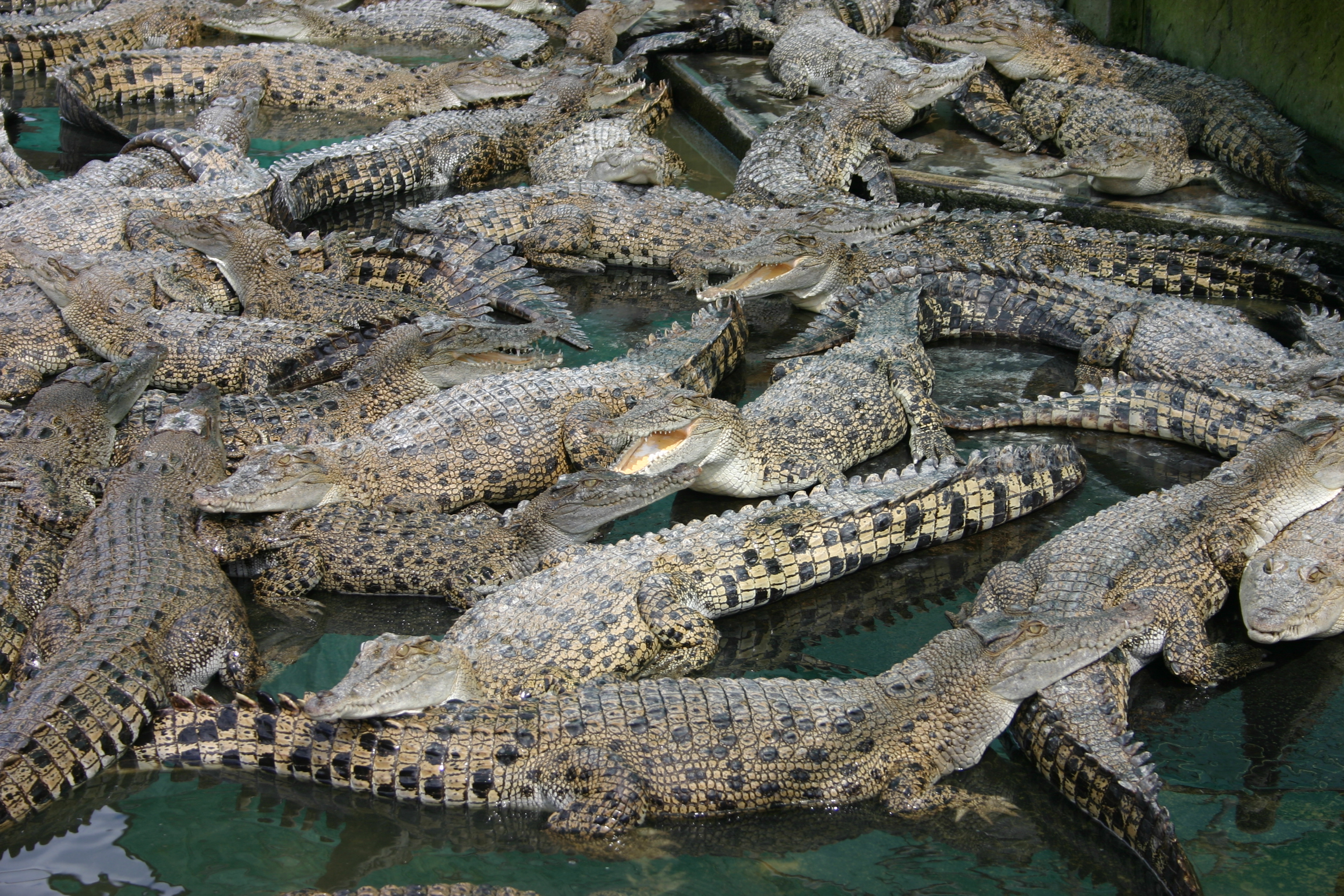
The eggs for the rearing process are laid by crocodiles around various large pools, where crocodiles build nests, a pile of vegetation, and lay the eggs in the nest. How are the eggs collected? Very carefully indeed.
We took a boat trip along one of these large ponds, and saw several crocodiles, some close to the boat. We went to see crocodiles being fed. The fully grown ones can be up to five metres, and rear up when meat was thrown to them, opening wide, and then shutting their jaws with a very loud “clop”. Apparently crocs can last for months without food. This can be advantageous if you are caught by a croc – you simply thrash around a lot (presumably you will be doing a lot of this anyway) shout a lot (ditto) and the croc may decide that it’s not worth the effort. Or it may not. Since crocs are good swimmers but poor sprinters, it probably best to stay away from the edge of the water. Especially where there is a “Beware of the crocodiles” sign.
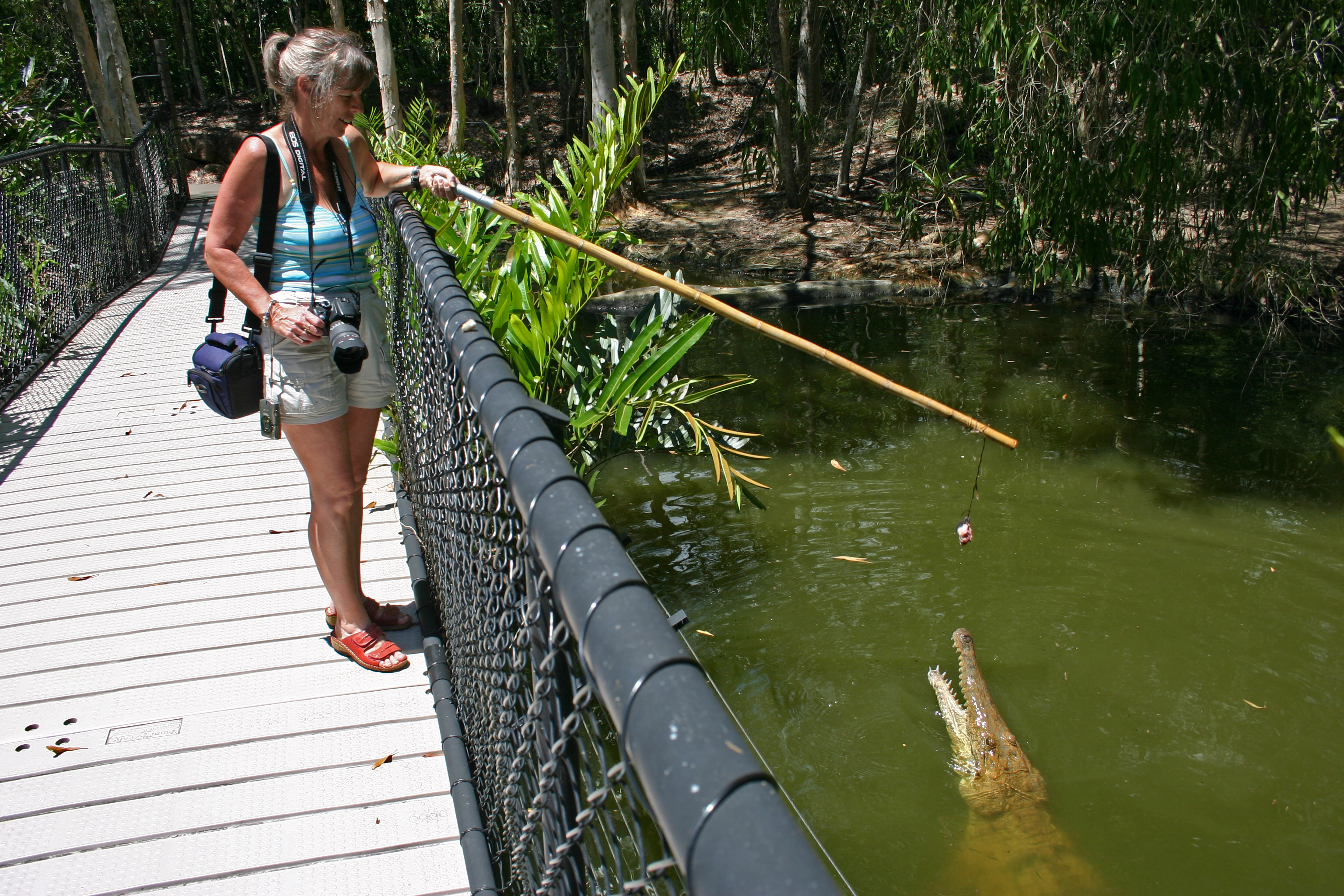
We were able to feed the crocs ourselves. Not these big fierce buggers, but the smaller river crocodiles in another area. Feeding them involved taking a long pole, and dangling a chicken head from the end on a length of string, fishing rod style. By dangling it above a croc, you can encourage the croc to rear up, a good photo opportunity, and so I held the pole, while Chas held the camera. I dangled the chicken head, Chas rested her finger on the shutter, and the croc promptly took me by surprise by pinching the head before we were ready. Attempt two was more successful, as were Chas’s attempts, and we got our photos.
We toured the rest of the farm, effectively a zoo. We had a talk about snakes; saw our first koalas, which were some rather despondent specimens in an enclosure, and some cassowaries (large flightless birds with an unfortunate habit of getting run over and killed) in a similar state.
We left mid afternoon, and went back to Port Douglas to find the local “netted” beach for a swim. Port Douglas beach is called “four mile beach” for a good reason. Unfortunately only about 50m of it has a jelly fish protection net, and not surprisingly this area was very busy, and so instead we went for a dip in the swimming pool outside our apartment, before heading north for a night time rainforest walk.
We drove along a wide straight traffic free road, with fields of tall sugar cane on either side. We turned off along a smaller road, crossing the Daintree River on a chain ferry, and continued up winding roads through the rain forest, with dense trees and ferns on both sides, and with only isolated habitation. We eventually arrived at the appropriately named Coopers Creek at dusk, but as we were an hour early for the night walk, we backtracked and found a small restaurant for a meal.
We returned to Coopers Creek; farm buildings on the edge of the rain forest, and met our guide and the other two people in our “party”. We set off into the forest, torches in hand along forest tracks, and over the next two hours we saw a variety of wildlife that would not normally be seen during a daytime walk. Large huntsman spiders were everywhere. We saw lizards, giant crickets, a white marsupial rat, and a wallaby crossed the path in front of us. I hung back to see what I could see, and spotted a large brown snake beside the path, and called the others back to see it. We saw a small bird asleep on a slender twig, too thin for a snake to climb. A wild pig crashed through the undergrowth not far from us, startling us all. Fireflies glowed in the dark – not the flashing ones that we have seen in the States, but steady points of light moving through the air. A pale coloured bat flew overhead, and we heard tree frogs, although didn’t spot any. We turned off our torches, to discover that the rainforest was as dark under the forest canopy as inside a cave. To add to the atmosphere there was a thunderstorm, with flickering lightening and thunder, and the noise of heavy rain on the tree tops. On the way back to the farm, we sampled exotic fruits from the trees in the orchard around the farm buildings.
We drove back along the road through the rainforest, a bit eerie driving through the darkness and dense trees, and we were glad to see the ferry. As we passed through the village of Mossman, a few miles before Port Douglas, we passed two young girls hitchhiking. It was after 11.00pm, and so we turned around and offered them a lift. They must only have been about 14, and allegedly had been let down by a friend who should have picked them up. There were a few unanswered questions about their story, but they were very polite and relieved and grateful for the lift.
Day 3 The Reef.
We were up early to be collected by the bus taking us to the boat for snorkelling on the Great Barrier Reef.
The trip to the Outer Agincourt Reef took over an hour and a half, and was very rough. We were the oldest on the boat – most were under 25, and many were feeling very sea sick. Part way out, many of the blokes, and one or two girls, went for scuba diving instruction, leaving some despondent young ladies feeling poorly and a bit lonely, and so Chas’s mothering instincts kicked in, and she went to talk to the particularly poorly ones.
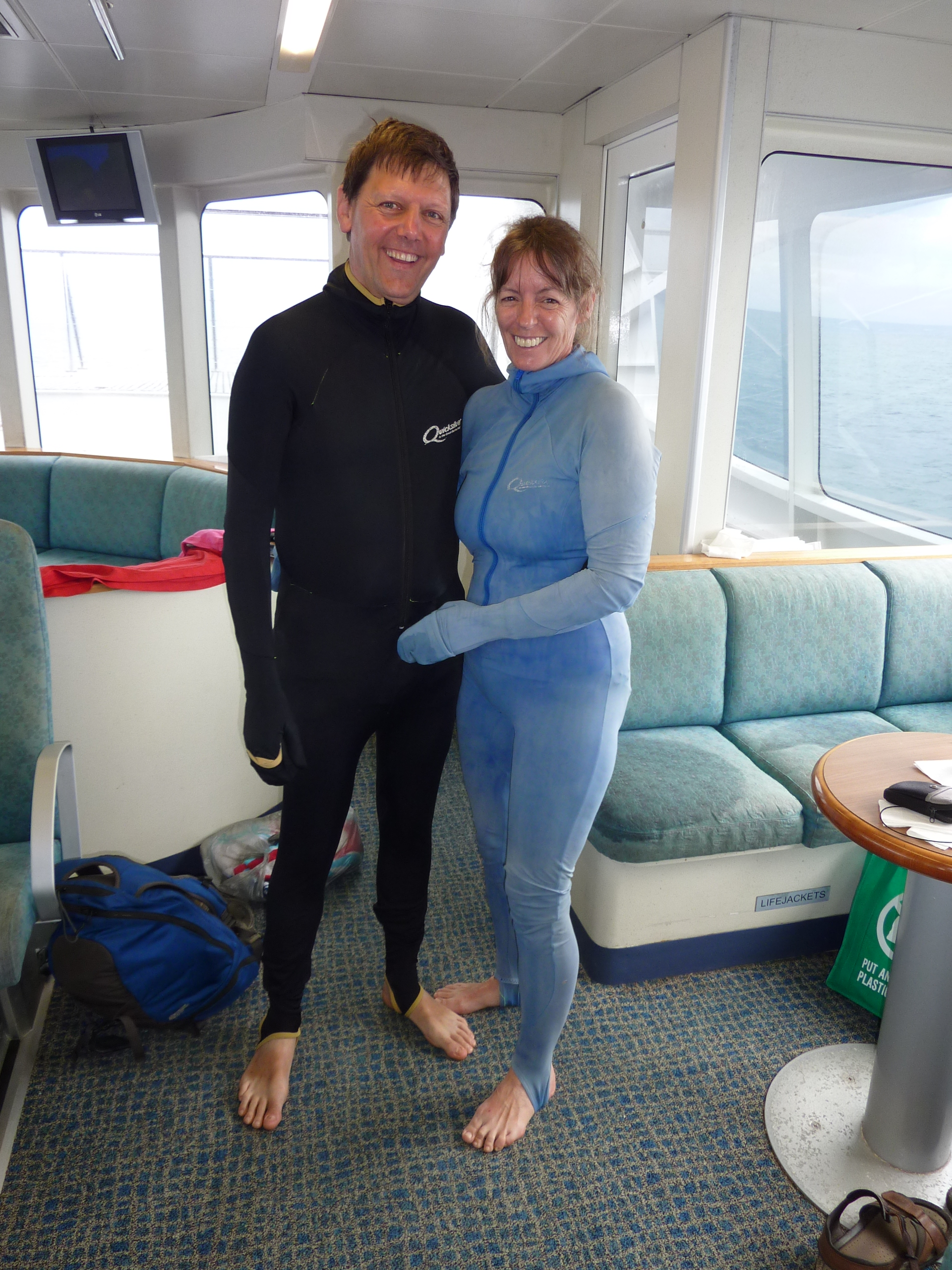
Shortly before arriving at the first reef destination, we donned Lycra full body suits as protection against jelly fish (what a sight that was), and collected our snorkels and mask.
We had a briefing directing us to where the nearest reefs were, and told not to swim further than 100m from the boat. A lookout on the roof of the boat would be keeping an eye on us. The Great Barrier Reef is not one very long living structure stretching thousands of miles off eastern Australia. It is very many individual reefs grouped along the length of the Great Barrier Reef. It is protected, and only limited areas can be visited.
When the boat anchored, we launched ourselves from a platform at the stern and started to swim, practicing our snorkelling technique. Chas swam a few metres, panicked, and came back. She tried a couple of more times, but each time the combination of floating above “nothing” (deep clear water by the boat), the potential of small wriggly fish coming to see her, and the effort of breathing through a snorkel was all a bit too much for her. She sat on the back of the boat getting her breath back, and then decided that snorkelling was not for her. She would be fine drinking tea and coffee on the boat.
I felt very guilty because I had persuaded her to go snorkelling instead of going out on a glass bottomed boat. I felt snorkelling was experiencing the reef, but a glass bottomed boat was like watching it on TV. Once Chas had agreed to snorkel, we had chosen a smaller boat, with no glass bottom, because it visited more locations, and was $70 cheaper. Now Chas would not even get to see The Reef. I was very disappointed, but knew that once Chas had decided that she didn’t have the confidence to snorkel, she would be stressed if she continued to try.
I set off on my own to join the other snorkelers spread out across the Reef. Below me was deep very blue water, with a sandy bottom and a few fish. The water got a bit shallower, and then I came what is best described as a cliff of coral, rising from the bottom, and then forming a “plateau” about a meter below the surface, but with deeper crevices, hollows, and caves. Even though the day was overcast, it was bright, and the coral glowed with a wide variety of colours, with waving anemones and giant clams. The clams were difficult to spot at first, because the “lips” generally had anemones growing on them, but I soon got to recognise the shape. The coral was teeming with fish of all colours, not just in groups, but everywhere, with the smaller ones coming right up to me, swimming between my arms and mask. Much bigger fish were visible a couple of meters below me, and I saw small fish cleaning the mouths of big fish. I had swum out with a “noodle”, a length of foam to help buoyancy. I was able to “dangle” from this and just watch all of the activity below me.
It suddenly occurred to me that at 52 years old I had just been skiing for the first time, and now not only was I snorkelling for the first time, but that I was doing it over the Great Barrier Reef. I couldn’t stop a big grin. This was not good. Grinning and snorkelling don’t mix, and I got a mouthful of water, and had a coughing and spluttering session before returning to the boat to tell Chas what I had seen.
Chas wasn’t on the platform at the back of the boat, and so I assumed that she had gone inside. I hauled myself onto the platform, wondering whether to take off the suit and go and find her, but then one of the safety instructors swam up, followed by someone snorkelling in a Lycra suit the same colour as Chas’s. “Is that my wife?” I asked, and she nodded. She had talked to Chas, and persuaded her to be towed out, using a large float for support, and Chas had been to the nearest Reef. That was all she needed – she had gained the confidence to float, swim and breathe, and had been as fascinated in the life of the Reef as I had been. She wanted more of this, and so we set off together to explore further.
About an hour later the boat siren summonsed back to the platform. The next site was over an hour away, and so we dried off, and went inside. It was at this point that I made an unfortunate discovery in my pocket. I am now the proud owner of one of the few Nokia mobile phones to have been snorkelling on the Great Barrier Reef. You will not be getting a call from this famous phone. Incidentally Australian bank notes are much better at swimming than my phone. They are made of plastic for a good reason.
We all went to the outside top deck for a brief illustrated talk on the fish and other life that we had seen, and the scuba divers reported seeing a shark close to where we had been snorkelling. The boat anchored again, and lunch was served – an excellent buffet with endless tea and coffee. Then we were off snorkelling again, this time dividing our time between “The Castle”, a sort of mountain peak, small enough to swim around, and a much larger area of coral further out. Chas got a bit tired, and returned to the boat a few minutes before the siren, which unfortunately gave her the opportunity to photograph and film my appalling snorkelling technique from above.
At the final location, we were accompanied by one of the instructors, who gave a sort of guided tour of the life below, identifying the fish, making a giant clam close up, and bringing up some specimens for us to have a closer look. Has anyone else cuddled a sea cucumber?
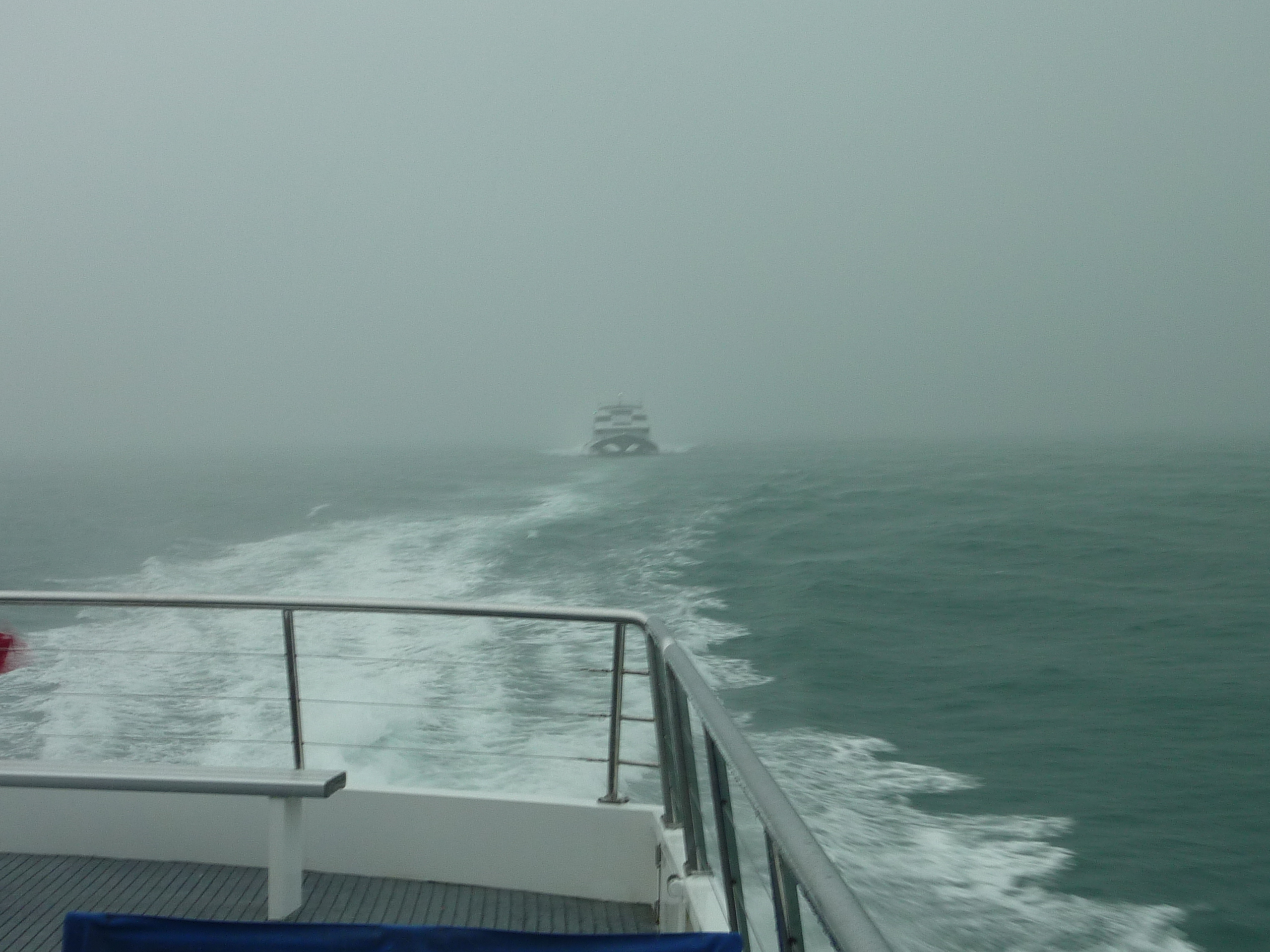
During this final snorkel I looked up to see who was splashing me, and saw torrential rain. On the way back to Port Douglas, it was even rougher than on the way out, with wind, heavy rain, spray and with thunder and lightening on the horizon. Chas and I stayed outside on the rear deck, under an overhanging roof, enjoying the weather.
Despite being the oldest people on board, we had been among the few to spend every available moment snorkelling, right up to the final siren. I ended up with blistered toes from the fins, thus uniquely having toes suffering from Alpine ski damage and Barrier Reef snorkelling damage at the same time.
The rainstorm continued for most of the night. It was a nice relaxing evening at the apartment – I sat on the sheltered patio reading a book and enjoying a G & T or two, with the noise of the rain on the plants and swimming pool a few feet away, while Chas downloaded photos onto her laptop.
The Great Barrier Reef experience was probably the highlight of the entire holiday. I was immensely proud of Chas for overcoming her fear so that we could explore the Reef together.
Day 4 Rainforest and retail therapy.
A more relaxing day taking a train through the rainforest up to Kuranda, a hilltop village, originally a mining community, but now a tourist venue, famous for it traditional craft market, and then returning on the Skyrail cable car through the forest canopy. We set off early for the hour and half drive to the pre-booked bus shuttle that would take us to the railway, leaving our car at the bottom of the Skyrail for our return journey. We were almost late – we took a brief detour for photographic purposes, and then took a wrong road, which twisted and turned for quite a way up into the hills before we could turn around.
It was a pleasant, rather than exciting, trip up the railway, with plenty of photo opportunities to keep us amused. We sat with four slightly older people, a couple from England, and their Australian based In-Laws. One of them was a very nice lady (we do seem to keep meeting very nice people) who gave up her window seat for much of the journey so that I could take photos. It was a hot day, and we were glad to leave the stuffy carriage at the top.
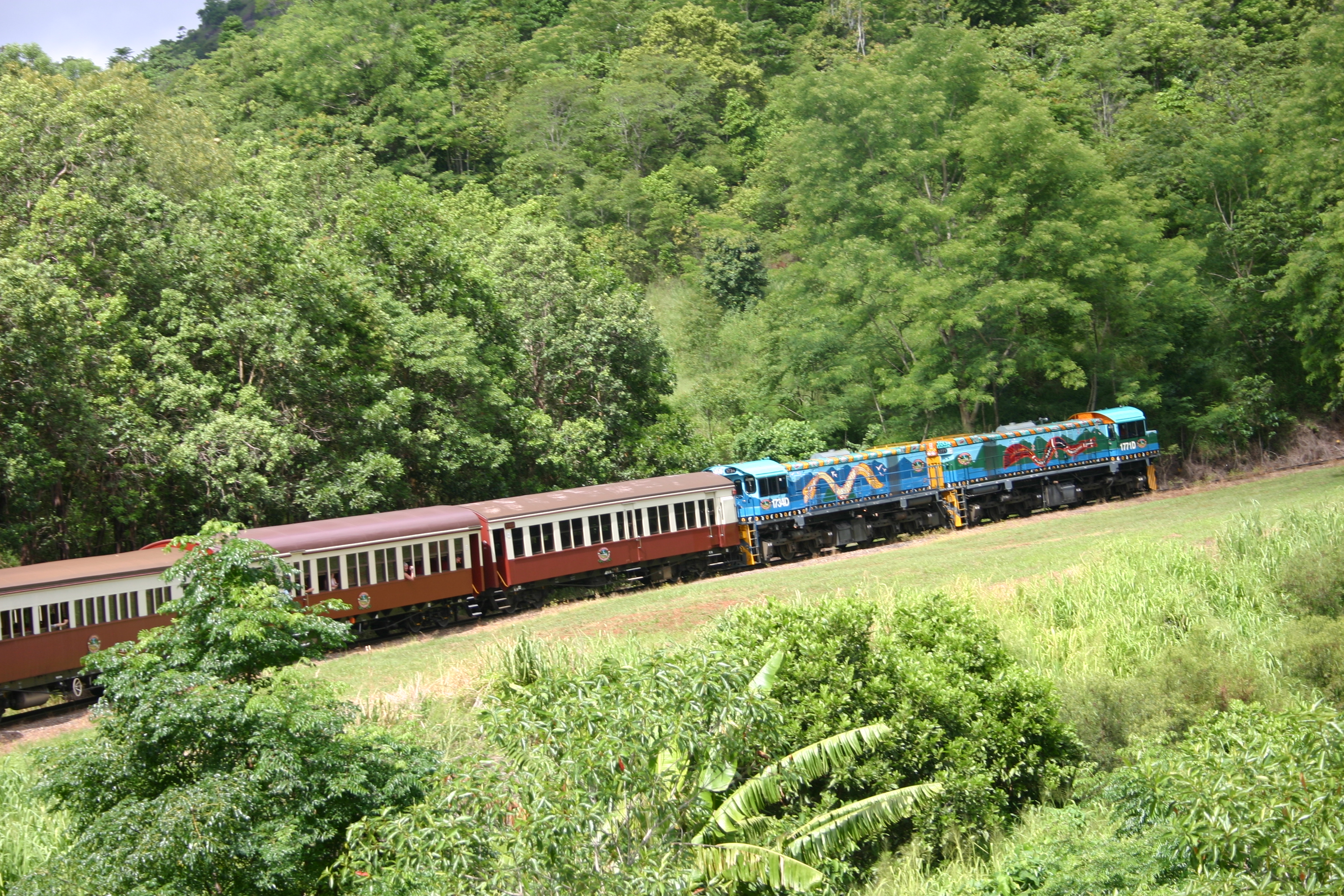
Kuranda is almost entirely devoted to tourism. The streets are lined with cafes, bars and souvenir shops, with gifts of varying quality, but we headed past these to the craft market, where more traditional items, plus better quality gifts, were on sale. We browsed for a while and I found suitable (at least I thought so) locally made gifts for the kids and parents, before we found a café for a beer, coffee and snack.
Throughout our trip Chas had trouble finding the right café or bar. Her idea of heaven is a coffee in the sun. Everyone else’s idea of heaven is a coffee (or maybe beer) in the shade. It generally took us some time to find somewhere with a table that had a chair in a position that allowed it to be dragged out of the shade of the café canopy.
We made our way to the Skyrail, browsing the souvenir shop and noting that every item was made in China, before catching a cable car down. The Skyrail cars are suspended above the forest canopy, sometime only about three of four metres above it, and we could see a variety of birds, particularly cockatoos, common throughout Australia. Interestingly the canopy was made up of trees together with ferns that you would normally expect on the ground (or in a UK conservatory). These were either growing in branches, or had climbed trunks. Part way down we got off at a station, and enjoyed a brief guided boardwalk with a couple of forest rangers, who pointed out and named the different trees and plants.
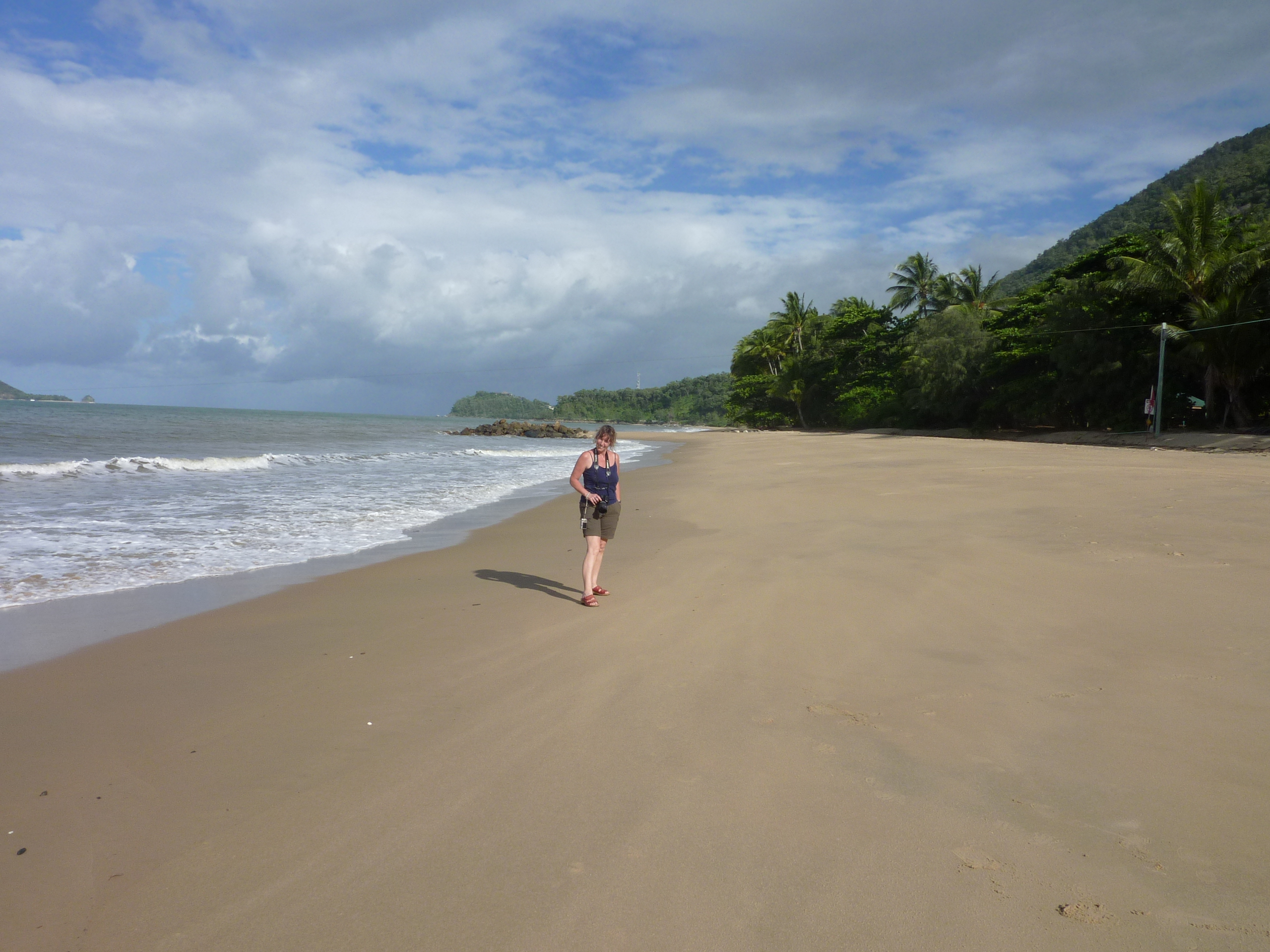
We headed back to Port Douglas, stopping at Ellis Beach, by the bar where we had stopped on Day 1. We had a lovely walk right along the beach (even bravely paddling at the very edge of the crocodile and jelly fish infested sea). A sign advised of “extreme” sun strength with a burn time of 6 minutes. Chas noted that after an hour, she hadn’t even gone pink. For some reason she decided to video me taking my shoes off to paddle across a stream. It wasn’t until we watched the video later that we saw a significantly sized crab come scuttling along the beach, run up to my feet and run away again, before following me into the river. Neither of us noticed it at the time.
Back at Port Douglas we stopped to photograph flying foxes. We had regularly noticed a group of trees by the road into the village, full of these suspended huge bats, screeching and flapping their wings to keep cool.
Chas decided that she would like a didgeridoo, and so we visited the didgeridoo shop in Port Douglas, where I was allowed to have a go at playing one. I successfully made the right noise, but wouldn’t actually describe it as musical. As always Chas had the blinkered approach to product choice, and appeared to only see the most expensive instruments – the didgeridoo of choice was A$450, plus A$110 carriage – about £400. We decided to think about it. In the end we returned the next day and bought a nice authentic boomerang/killing stick instead.
We had a last meal at a friendly bar, enjoying the warm evening, before going back to the apartment to pack ready for the flight back to Melbourne the following day. We had really enjoyed our time in Port Douglas, even preferring it to Sydney. We’d love to go back one day.
We almost stayed in Queensland longer than planned. On the last morning we spent a bit too long having a last look at Port Douglas, and then got caught up in a traffic jam in Cairns. We parked the hire car less than 10 minutes before final check in time. Fortunately the Avis rep came straight out to us to check the car, and we ran into the terminal, where, after a brief but frustrating wait in a queue we checked in with one minute to spare – the nearest we have ever got to missing a flight.
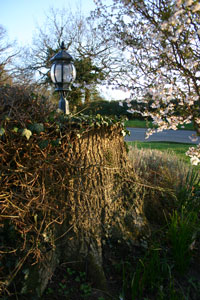 Technically we live in Oaktree House, but sadly the tree had to go.
We now have a thriving Oakstump at the front of the house.
Technically we live in Oaktree House, but sadly the tree had to go.
We now have a thriving Oakstump at the front of the house.