

Thursday 4th June
I, along with the rest of my team, have been given a plan for returning to work, although it lacks some minor detail, such as exactly which building we will be working from. Teams dealing with commercial premises have continued to give advice and take action, although with many businesses closed, I am not entirely convinced that they have been operating to full capacity. Since most of us in my Team work from home outside of the city, operating a callout service has not been practical, and social isolation rules have prevented house visits to witness noise. Consequently, Councillors and local MPs have been inundated with complaints that we are not dealing with noise from neighbours. Which is true. I suspect that MPs have not been inundated with businesses demanding that a Health and Safety Inspector pops round to see them. Most complaints are about music late at night, and so our night time call out service will be the first to resume, which pleases me greatly.
I receive an e-mail from a disgruntled architect, upset because I have decreed that an assessment of the late-night noise from a street needs a late-night noisy street to assess, and consequently he must wait until the streets at late at night are noisy again. Apparently this is an unhelpful delay and unfair to developers and businesses who are trying to kick start projects. He is, of course correct. To be fair to future occupiers, ensuring that they can sleep, I must be unfair to developers and businessmen who have to be patient for a while. The architect assures me that there must be other noise surveys that I can use to predict noise levels. I will invite him to find one, submit it, and I can decide if he has managed to find an identical street elsewhere that just happens to have hosted an acoustic survey.
This evening I consider the request by the youth worker associated with my church to host a weekly Zoom course from a room in the church building. I think that he feels that he is merely making use of a room in an empty building, but it is so much more than this. It is the first step of opening the building during a pandemic, and there are a lot of implications to think about. In my “risk assessment” I must assume that he, or his lodger, is asymptomatically infected with Covid-19, maybe subsequently developing symptoms, and I must minimise the risk of contamination to the building, and infection of subsequent users. I must also assume that the building has been contaminated during recent regular visits to check that all is well, and that I need to protect the Youth Worker. The Youth Worker must be alone, must disinfect all equipment brought from his home, sanitise his hands, disinfect all door handles on the way in, sign in with his own pen (into a book that we don’t yet have) use the room closest to the entrance, and disinfect light switches and other equipment used. After the Zoom meeting he must again sanitise or wash hands, disinfect, and sign out. Any subsequent Covid symptoms must be reported, which will mean a deep clean of the room and the access route to it, by someone wearing suitable PPE. Guidance on cleaning is available, but not on appropriate PPE. And someone needs to volunteer to wear it. Pre-Covid such precautions would be associated with a secret lab involving germ warfare. This is so much more than “Is it convenient for me to use the room?”
I am convinced that Zoom will be the most popular word of the year. Tonight I get together on Zoom with my sisters and two cousins. I Zoom with my sisters regularly, but haven’t spoken with my cousins for a while. It is only two months since video-chatting was awkward with long silences. Now it is like chatting in the living room, talk flowing naturally for an hour and a half until Zoom finally ejects us when we reach the time limit for a second time.
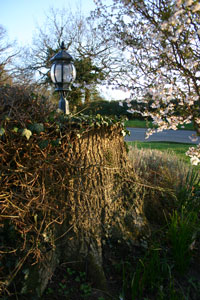 Technically we live in Oaktree House, but sadly the tree had to go.
We now have a thriving Oakstump at the front of the house.
Technically we live in Oaktree House, but sadly the tree had to go.
We now have a thriving Oakstump at the front of the house.