

Wednesday 3rd June
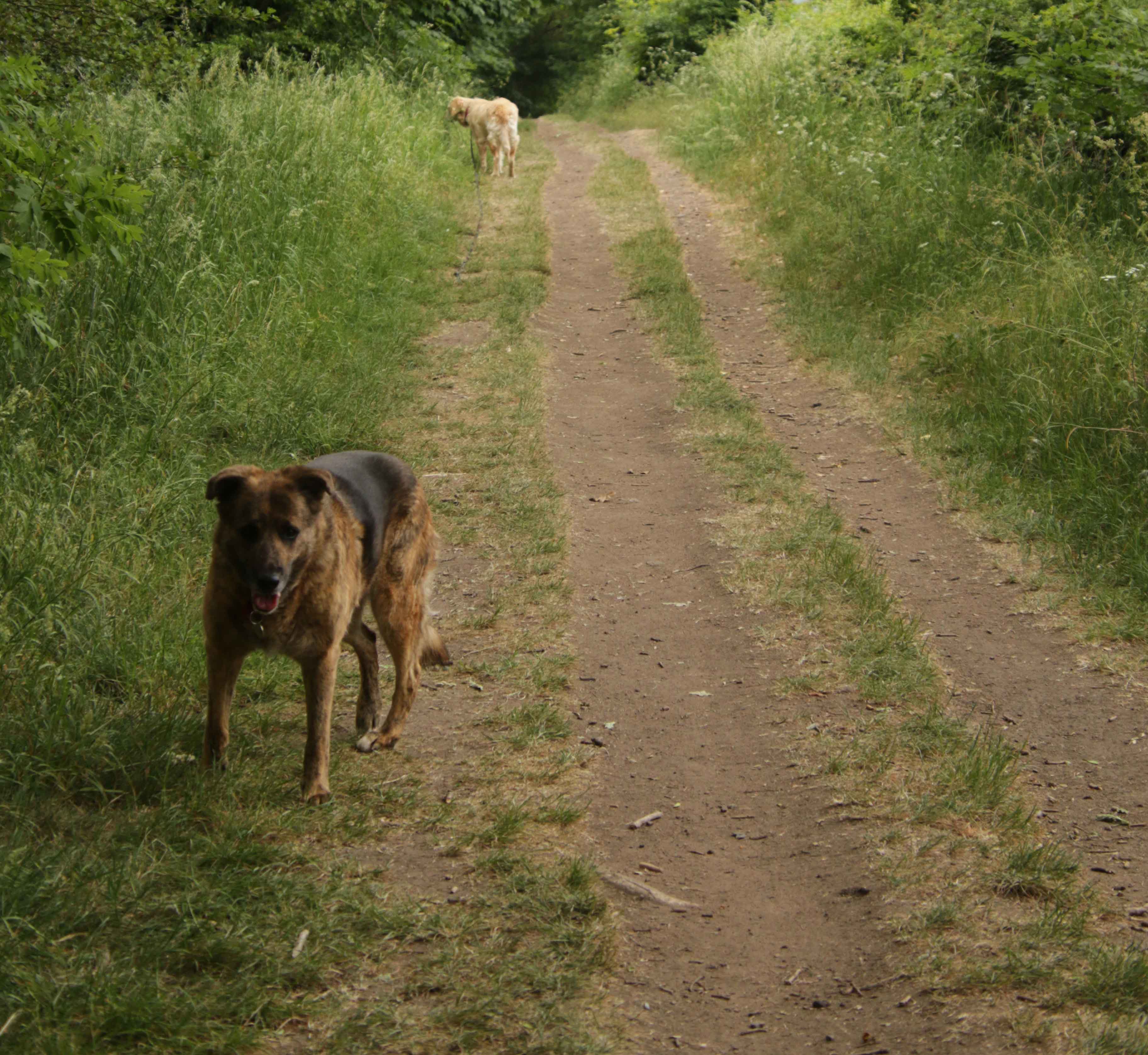 This morning I wake to a day that is cool, grey, breezy and spotting with rain, and consequently the morning dog walk is bliss. There are no people on Croft Hill, and the path down to Croft Glebe is quiet and deserted. This a dose of normality after experiencing a hint of what it must be like to live in a tourist hotspot, thanks to a combination of the partial relaxation of lockdown, and warm sunny weather. On the way back we meet a couple of locals, who we often meet when out and about, and we agree that it is nice to have the Hill back to ourselves. Those gathering on the Hill last night were noisy until well after dark, but at least seem to have bagged their rubbish and left it by the gates onto the Hill, unless earlier dog walkers have done some tidying up.
Working at home, and it is a day of negotiating around the limitations caused by lockdown. An application for a proposed residential estate of low-rise flats should include results of a traffic noise survey, and, if required, acoustic glazing to keep the noise out. The developer wants to go ahead now, with a condition that the survey is undertaken and glazing agreed once traffic noise is back to normal. I have no problem with this, but I point out that if the survey identifies excess noise, then this means the option of keeping windows closed, which means mechanical ventilation which means ducting, which means raised ceilings and grills. The Height and appearance of a building is normally proposed at the application stage. The applicant will need to design-in ducting before being certain that it is necessary. The planner and applicant will consider the matter.
It occurs to me that if live traffic flow measurements and records of previous “normal” traffic flows are available, then a comparison can be made, and current noise measurements adjusted to predict “normal” traffic noise. I e-mail a contact in Highways. Budget cuts over the last decade means that traffic counters have not been replaced, and just two remain, neither at helpful locations. For some reason city centre car park use is monitored, and my contact sends recent data up until 3rd May, the latest available. On the day after lockdown occupancy of city centre car parks plummeted to between 5% and 10% of normal use, rising slightly at the end of the period, when lockdown rules remained, but maybe attitudes were relaxing. Future data, as lockdown relaxes, may be interesting, a thermometer indicating the post-Covid health of the city centre. When licenced premises re-open, it will also indicate whether they and the streets around them are as busy as pre-Covid.
A consultant calls to discuss two other city-centre residential developments. One is not affected directly by pubs and clubs, but, once the “night time economy” resumes, will be affected by taxis and people travelling on foot between venues. His client has agreed that, with shops beginning to re-open, late afternoon street activity can be used to assess how noisy the area will be at night after licenced premises are again operating.
The second project discussed is for flats adjacent to a bar, and surrounded by restaurants, many, under normal circumstances, with tables outside. We consider surveys that the consultant undertook last year on other streets close to the city centre, but none have the same character as the location under consideration. I tell him that this assessment must wait until whatever the “new normality” brings. At the moment all is too quiet.
I receive an e-mail from a member of my church. A youth worker linked to the church has been running “Zoom” activities for groups from his home, but he has been finding it difficult, living in a small house with a lodger who shares the living space. From next week he is running a weekly “Alpha” course via Zoom, and would like access to the church building, closed since March, to present the course in privacy. I am asked to assess the risks and precautions. This will be an interesting exercise, a rehearsal for the gradual opening if the church over the next few weeks, any second Covid peak permitting.
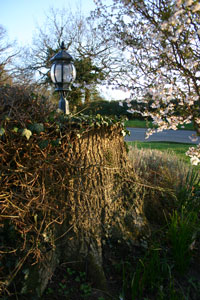 Technically we live in Oaktree House, but sadly the tree had to go.
We now have a thriving Oakstump at the front of the house.
Technically we live in Oaktree House, but sadly the tree had to go.
We now have a thriving Oakstump at the front of the house.