
Day 1 – Summer has arrived.
We woke up remarkably fresh after a good nights sleep. The rest of the family were up and about – it was great to see the girls again. Chas returned to bed suffering from a combination of jet lag and a cold, while Bridget and Megan soon involved me in some artwork. 3 ½ year old Bridget is a traditional crayons artist – complex designs on Daddy’s computer paper. 19 month old Megan is more water colours. In my day children’s water colours involved a jar of water, a small paintbrush, and a book of drawings, with colours that emerged when wet. The book hasn’t changed much – Thomas the Tank Engine in this case. The water application is more hi-tech – a felt pen filled with water instead of ink. It’s much more fun with the potential of a jam jar full of murky brown water being spilled across the table.
It was singing day for the girls – a weekly half hour activity session in nearby Williamstown, led by a very pleasant young lady with a dozen or more children enthusiastically singing action songs. Grandparents were welcome to join in – I was conspicuously the only middle aged bloke among a bevy of 30-something Mums. Oh well, one has to make a sacrifice for one’s grandchildren. At least I knew most of the songs. “Wheels of the Bus” was familiar to everyone, but Chas and I seemed to be the only ones who knew “Riding along on my push bike, honey”, probably because it pre-dated the Mums by about 20 years…
Later we all went to the Williamstown shore of Melbourne Harbour for a picnic in the shade of trees. This was exactly as I expected Australian life to be. Hot sun, shady trees, shimmering water under a blue sky, and a picnic blanket on the ground laden with goodies, and ice cream to follow. I admit that I snoozed a bit while Lucy and Grannie Chas played with the girls in the nearby playground. I could cope with three weeks of this.
The trip to Williamstown gave us a chance to view the local neighbourhood. Chris and Lucy live in Sanctuary Lakes, a quite exclusive development to the west of Melbourne. Chas likened the development to the residences of the Desperate Housewives TV series. Melbourne is suffering from chronic urban sprawl, with very large developments of big detached houses, and acres of grassland about to be developed. The Australians have an interesting process for buying a new-build home. The owner of land sells individual housing plots – just the land, not the houses. Developers build show-homes on the site (maybe four or five individual developers, generally national companies, similar to Barratt or Davies), and purchasers choose a design which is then built by the developer. The result is a mix of a few house designs, but because the owners of adjacent plots are likely to have chosen different house designs, and because each design may have different details (for example with or without pillars or balconies) the overall development is less uniform than similar developments would be in the UK. However, the general impression is still of urban sprawl, rather than individual housing developments.
Day 2 – A Very British Picnic.
It was a typical English summer day – cool, grey and threatening rain. We all went to Werribee, a stately home an hour or so from Melbourne. We played hide and seek in the rose garden. Bridget hasn’t quite got the hang of this. “Bridget, where are you?” “Over Here!” and she hid by standing and facing into a bush, working on the If-I-cant-see-you-then-you-cant-see-me principle. We looked around the house, and I was persuaded to join the ladies by dressing up in period costume (Victorian, I think) for a photograph.
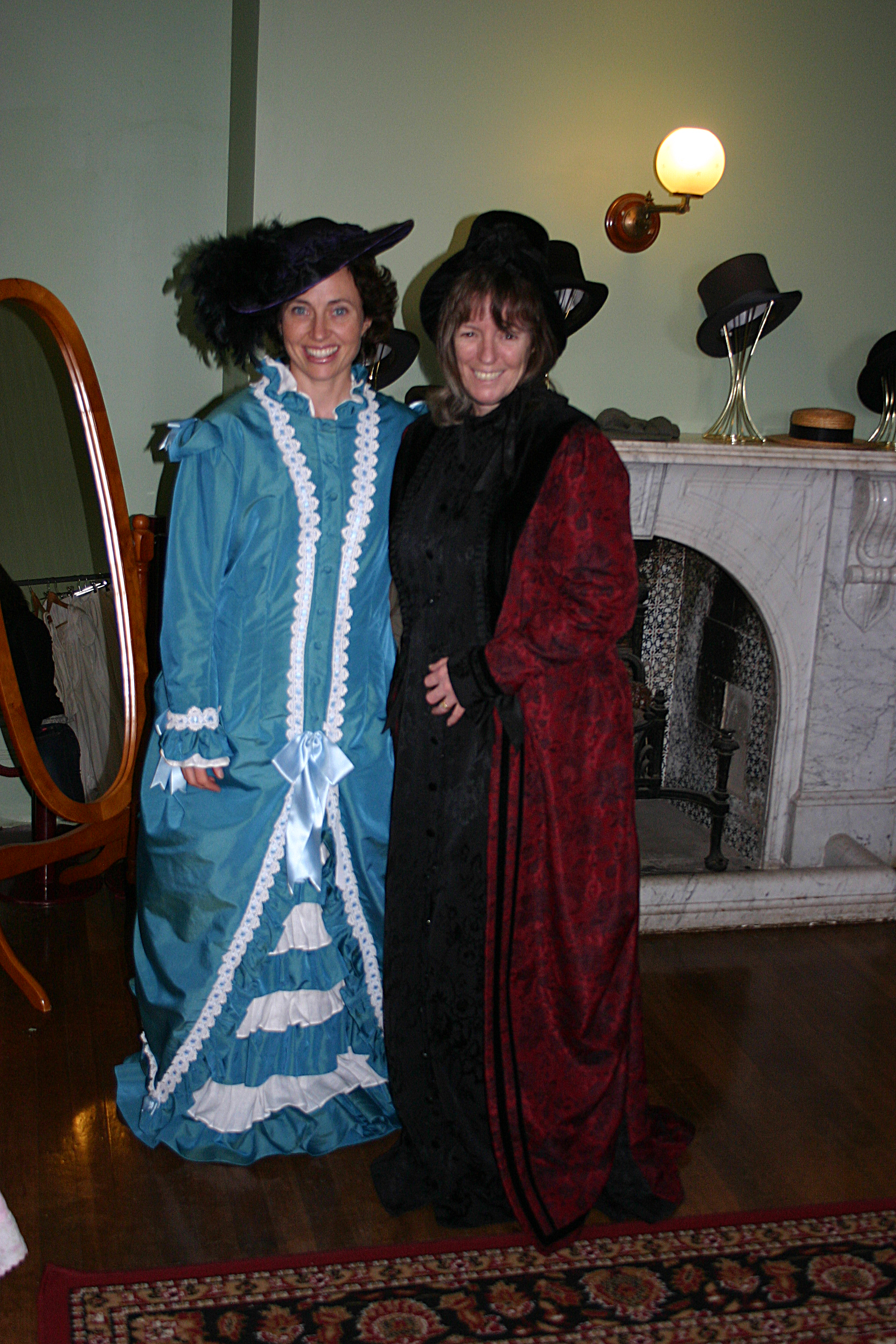
The house was built by a Scottish family, who arrived in Australia in the nineteenth century. They were typical of many early sheep farmers, arriving with limited funds, and purchasing a few sheep. With no land, and insufficient funds to rent, the sheep farmers squatted on land, often government land, previously occupied by Aborigines. This was tolerated in the interests of the growing economy. As profits grew, farmers rented, and eventually bought land, many becoming successful large scale sheep farmers.
Afterwards we had lunch at a picnic table in cold, driving drizzle, wrapped up in fleeces and waterproofs. This was more like Melbourne in Derbyshire than Melbourne in Australia However the rain cleared, and watery sun came out – not exactly warm, but it allowed us to run around with the girls, and explore the grounds. We walked over a small bridge to a tiny island with a folly on it, giving me an excuse to pretend to be the troll from the Three Billy Goats Gruff story. Everyone knows that that a little wooden bridge is likely to have a troll lurking beneath it. This became a bit of a theme during the holiday. “Be a Troll, Grandpa Coops!”
There were two weddings taking place in the grounds. One wedding party, near the aforesaid tiny island, was clearly waiting for a very late bride to arrive – she did so eventually. Maybe she was afraid of trolls. The other wedding was in the rose garden, and involved several marquees. These were not tents – they were the bride and bridesmaids dresses. Australia has just overtaken the United States as the most obese nation. I must admit that, although a few generously proportioned Australians were noted, I recall seeing more large folk in America during a trip a few years ago. To date the Australians have refrained from serving chips with everything, including breakfast.
Day 3 – Thomas The Tank Engine
A nice English summer day – cool, but bright and dry. We drove to the Dandenong Ranges, a hilly area east of Melbourne, to see Thomas the Tank Engine on the Puffing Billy heritage steam railway. Chris and Lucy had booked a ride on open coaches pulled by Thomas, and we all climbed on board, along with other families. After a few minutes, as the train set off with a severe jerk and loud clanking, babies began to wail, children screamed, and Bridget and Megan were not very impressed. However things calmed down, and we had a pleasant return ride to the next station, before seeing an outdoor “pantomime” starring Thomas, the Fat Controller, the fireman, and an attractive engine driver. She never appeared in the original books.
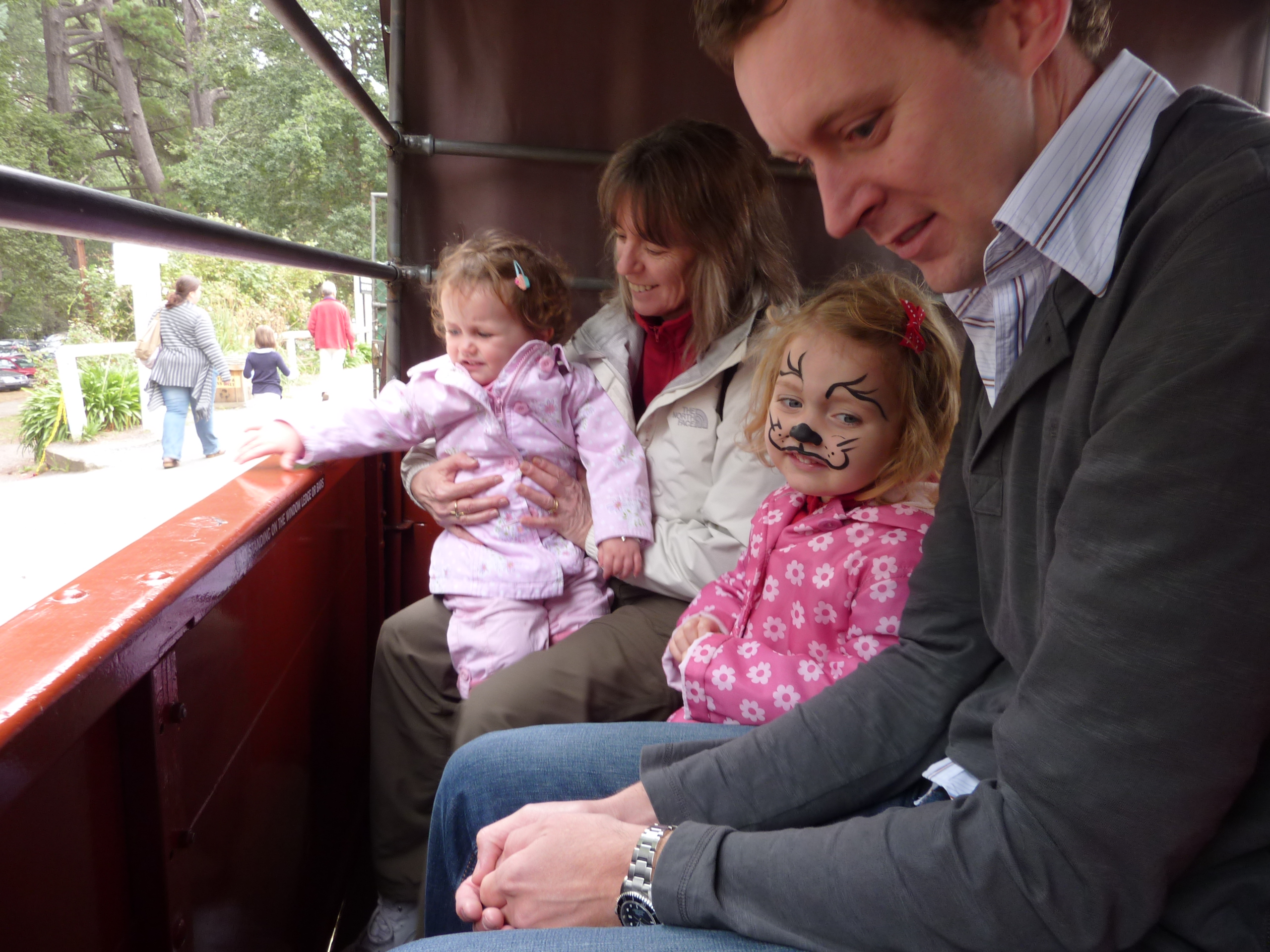
During the railway trip we had travelled through woodland that looked like a British deciduous wood, but with giant exotic ferns among the trees. We saw our first kookaburra, and colourful wild parrots. We then had a picnic in a meadow full of dandelions, next to the steam railway, with cockatoos screeching in the trees. Afterwards we drove on the left of very English roads, but with “beware of wallabies” signs, to a nearby small village where we had a Devon Cream Tea. What an amazing mix of Englishness and the exotic, which I suppose is typical of Victoria.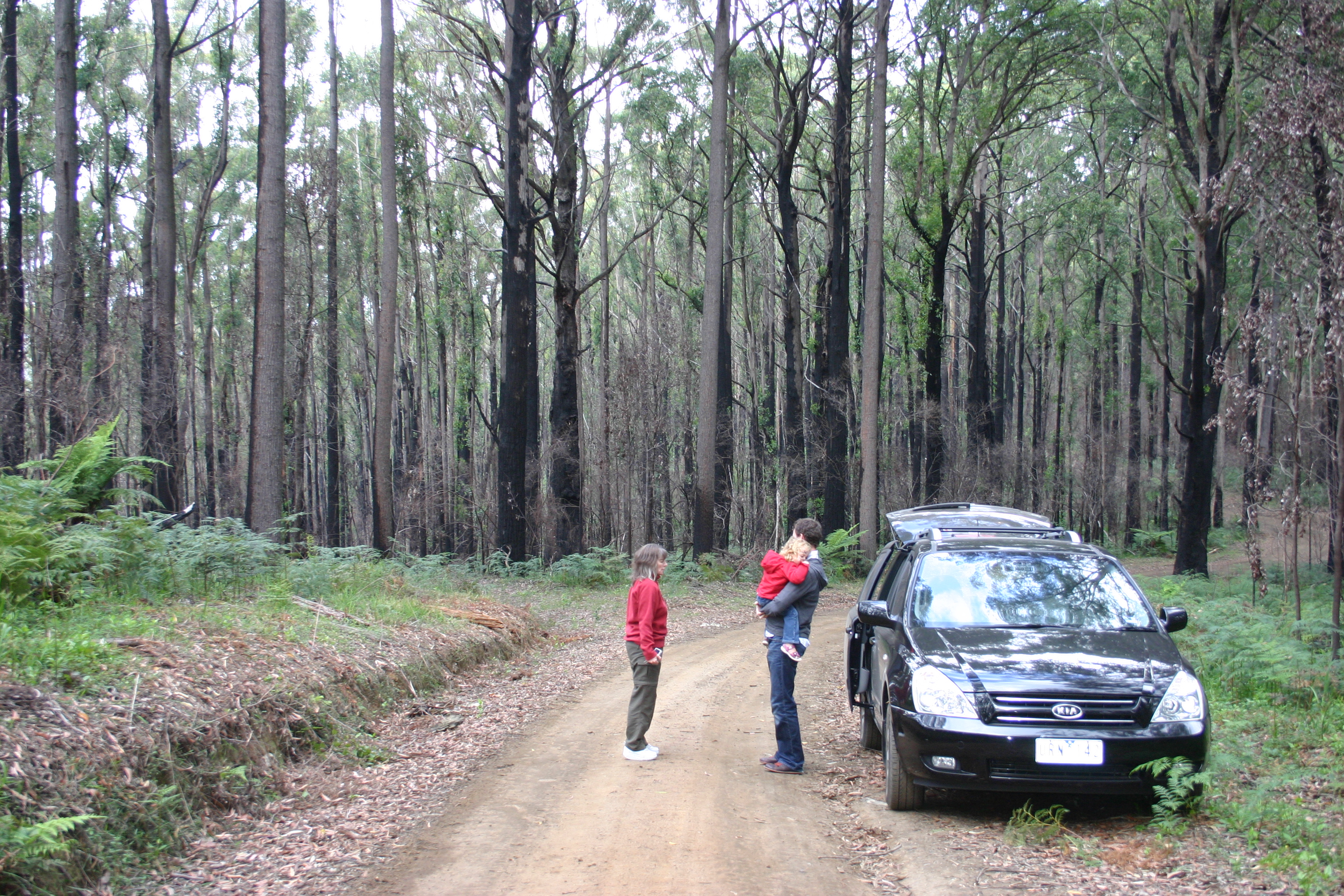
Later we decided to explore the local forest, with a plan to drive along forest roads to find somewhere to go for a short walk. Despite, or maybe because of, having a SatNav, we got lost on a road that began to deteriorate into a track. But the drive was fascinating, with massively soaring eucalyptus trees, and giant ferns, and a wallaby jumped across the road in front of us. This definitely felt Australian.
Day 4 – Gold!
Lucy and the girls took us to Sovereign Hill, a reconstructed mining town and living museum at Ballarat, a couple of hours from Melbourne. At last the weather was improving – it was hot and sunny, and the mining town was dusty, with horses and carts and lots of folk in period costume. With not very many tourists, it was easy to imagine being in the town during the mid 19th century gold rush, with hotels, shops, a school, banks, and a bakery, and a stage coach offering rides.
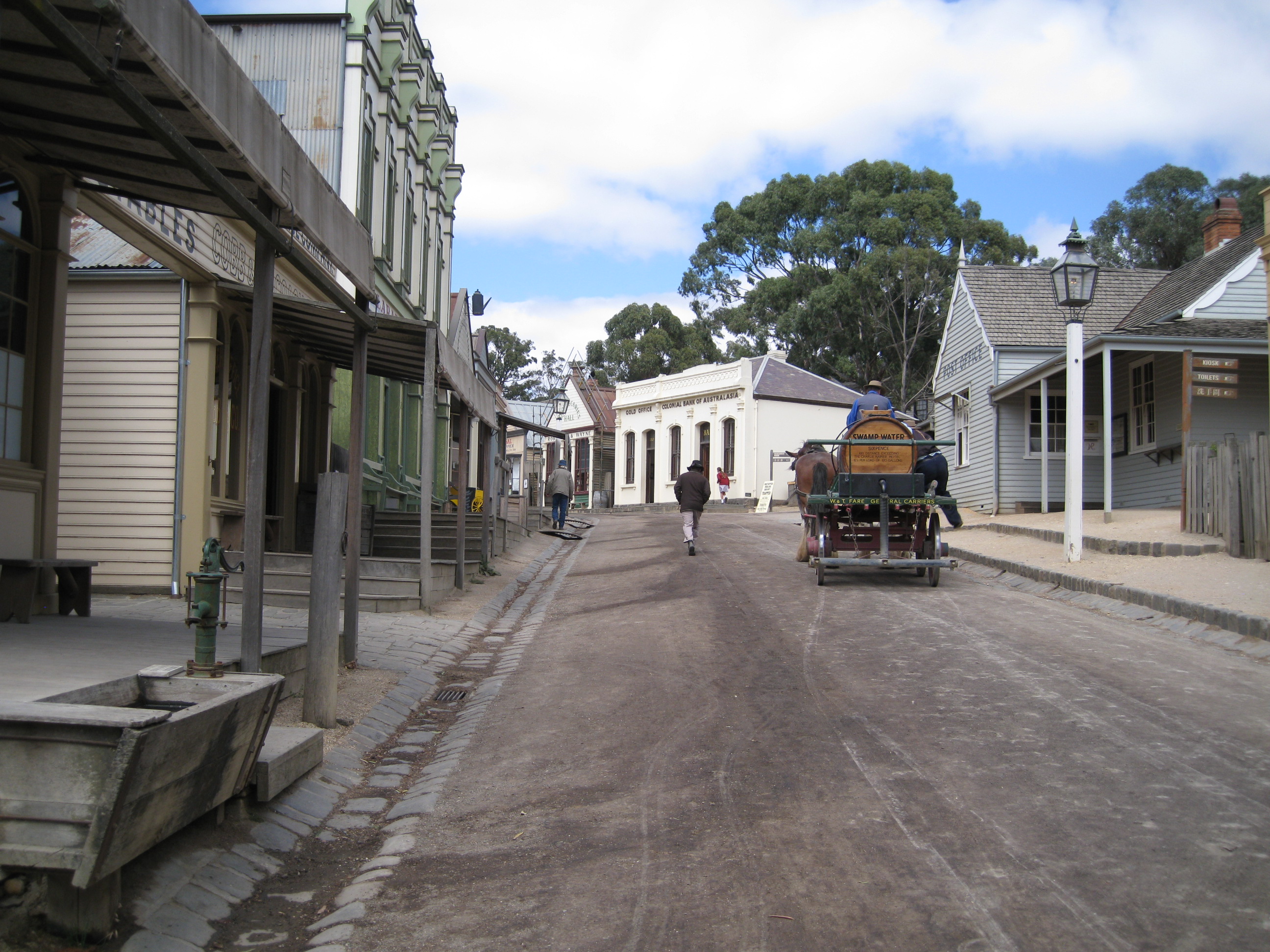
We saw the local blacksmith at work, and later watched molten gold being poured into a mould. While we were waiting for the gold-pouring, Megan flirted outrageously with one of the men working at the foundry, showing him her soft toy, and playing a game of “Oh-look-I’ve-dropped-my-monkey-will-you-pick-it-up?” He happily joined in, until we were ushered into the foundry area. After the gold pour Megan rushed out to go and find the man to carry on the game, even though he was behind a counter trying to sell various gold items to visitors. He was pleased to see her, and they exchanged big smiles. As far as I know, they didn’t exchange phone numbers.
The town photographer was taking photos of family groups. I was persuaded to dress up as a Victorian Gentleman and have my photograph taken with my lady wife, my daughter-in-law, and grandchildren. The ladies (but not the grandchildren) were a bit excitable, and I had to have stern Victorian words. “Daughter-In-Law! Kindly refrain from giggling!” Well, I had to get into character – after all, I’m not allowed to be stern in real life. Megan was given a period teddy bear to cuddle, but no way was she going to have her personal soft toy replaced by an old teddy. The resulting sepia photograph was quite good. Apparently (so the ladies told me), a Victorian costume suits me. And if you look carefully you will see a Victorian toddler cuddling a rather modern looking Millie-The-Monkey.
We lunched at the town hotel. Now my idea of lunch during a day out is a brief break before carrying on with the day. In this case pie and mash was on offer, which was perfectly adequate and reasonably quick. But I was with Ladies-That-Lunch, for whom lunch involved a main course, not to be rushed, followed by a leisurely cake and coffee. I wanted to be out and about again, and so when I saw a troop of redcoat soldiers marching by, playing music, I grabbed Bridget, and we went out to see what was going on. We followed the soldiers to the end of the street, where a crowd had gathered to listen to the Captain give a brief speech about a recent British victory. I thought that the band would begin to play again, and lifted Bridget onto my shoulders for a better view. The soldiers didn’t start playing again. Instead they raised their muskets to their shoulders. “Bridget” I said “there may be a bit of a bang”. There was a very loud bang, and I felt a startled Bridget leap several inches off of my shoulders. There was a second loud bang, followed by a wailed “MUMMY!!” from above my head, to the amusement of the rest of the crowd. We beat a hasty retreat back to the hotel.
There was another trauma for poor Bridget. As we were about to go up the garden path of a house there was a lot of shouting from an adjacent house, and big argument ensued between the occupiers of the two houses (dressed in period costume), about the smell from the cess pit at the rear of the house we were visiting. A rough looking man was doing much of the shouting – he had been sent to clear the cess pit, and there was a dispute over who would pay him. Bridget and Megan watched all this with wide-eyed astonishment. The man disappeared around the back of the house and all went quiet. Lucy was about to knock on the front door when it flew open, and the man shot out, almost knocking Lucy over, being chased by the lady occupier of the house beating him with a broom,. There was a lot more yelling as he ran out of the garden gate, just avoiding little Bridget. This was all too much, and both girls burst into tears, Bridget shouting “He’s a naughty man! He’s a naughty man!” She was not at all convinced when we tried to tell her that it was all pretend.
We ended the day by going down to the local creek to pan for gold. We each picked up a large pan (apart from Megan, who by now was fast asleep in the buggy), shovelled a load of gravel from the river bottom into the pan, and shook, rattled and rolled the gravel, gradually spilling it out of the pan.
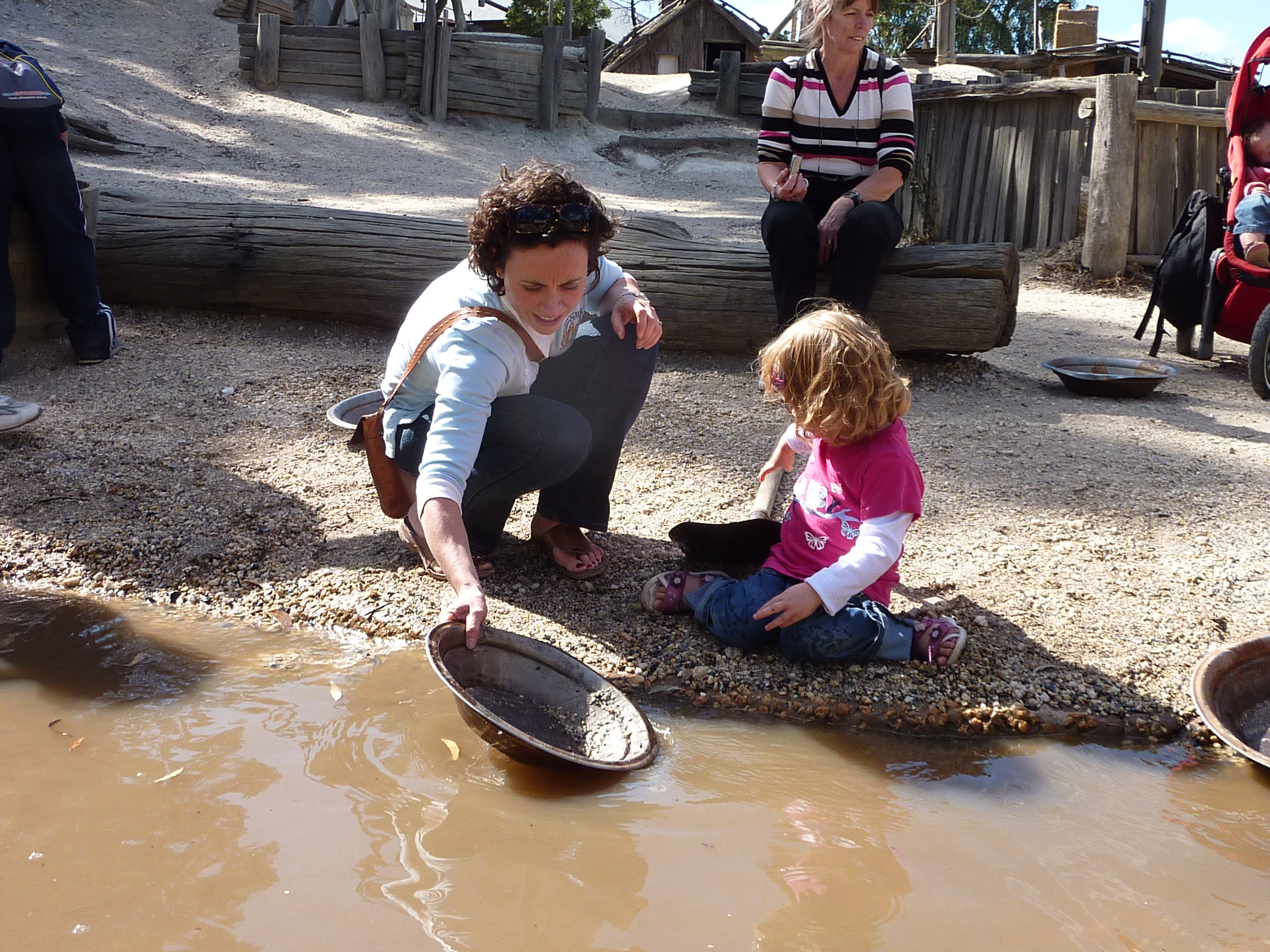
What was left at the bottom was basically a small quantity of mud. Eventually a nice man came over and showed us how to swirl and tilt a pan full of gravel, using water to gently wash the gravel out of the pan. This was quite a long process, involving repeated swirling, adding water, and washing the gravel out until all of the gravel had been washed out, leaving a small quantity very fine gravel particles, almost mud. There glistening in the bottom were particles of gold! It must be admitted that I needed to put my specs on to see the gold, but nevertheless after a few attempts we had quite a few particles to take home in a small container purchased for the purpose. I should explain that the creek, although quite long, was artificial, and each morning a single “clump” of gold filings the size of a pea was spread along the length of the “creek”. The filings were from a gold merchant, “waste” after gold jewellery had been altered. Apparently the amount of gold successfully extracted by panning is a lot less than the amount put in, and so the quantity of gold in the creek is gradually increasing. It was an interesting way to end the day.
Day 5 – Melbourne.
Chas and I spent a day together exploring Melbourne. Despite a suggestion that we get up at 6.00 am and get a lift to the City with Chris, we opted to catch the train instead, and Lucy kindly gave us a lift to the station. When I asked for the tickets I remembered not to be an obvious Pomme and ask for tickets to Melbourne. The correct Antipodean’s pronunciation is Melbun.
Chris had printed a map of the city for us, with some suggested places to visit. We crossed the city centre to visit some shopping arcades recommended by Chris and my guide book, and then to the Rialto Tower, where a 55th floor viewing platform allows a panoramic view across the whole city. The Victorian arcades were very nice, but the shops were expensive designer shops, and the arcades themselves seemed to me to be the same as those found in Leeds, and indeed in other UK cities. We navigated our way to the Rialto Tower, where, since the lift to the viewing platform was not obvious, we asked a very helpful receptionist to direct us. The viewing platform had closed permanently in December, and we were redirected to the Eureka Tower, about a 20 minute walk away, which also had a viewing platform, where we opted out of paying extra for the “glass box” that slid out of the side of the platform. We have stood on the glass floor of the CNN Tower in Toronto, which is much higher. What international jet-setters we have become!
Afterwards we passed a stylish coffee shop at the base of the Tower. “Do you want a coffee?” asks Chas. “No, I’m fine.” I reply. Very shortly afterwards Chas explained at some length that “Do you want a coffee?” means “I want a coffee!”, and so we found a nice little coffee bar at the base of one of the footbridges across the River Yarra, which runs through Melbourne, and enjoyed a coffee and sandwich surrounded by water.
On the subject of coffee, I enjoy a nice cup of reasonably strong ground coffee. It is becoming increasingly difficult to ask for a cup of reasonably strong ground coffee at a coffee bar. One is presented with a long list of coffee types, without any indication of which of these may possibly resemble a cup of reasonably strong ground coffee. In the UK it has taken me some time to discover that when I want a cup of reasonably strong ground coffee, what I mean is that I want an Americano with a dash of milk. Americano does not exist in Australia. Or at least it does, but it isn’t called an Americano. With the help of Chris and Lucy I soon learned to ask for a Long Black. I wonder what one would get of one asked for that in the U.S?
It was now lunchtime and all we had seen was what we wanted to go and see, as viewed from the top of the Eureka Tower. We caught the free tourist bus that circumnavigates the City and headed for the Fitzroy Gardens to visit the cottage where Captain Cooke grew up which had been rebuilt in Melbourne after being transported brick by brick from North Yorkshire in the 1930s. It was an interesting place, and we had some quite long chats with the staff there. Captain Cooke’s wife outlived her husband and all of her six children, living alone in the cottage for about 30 years. Quite a sad story.
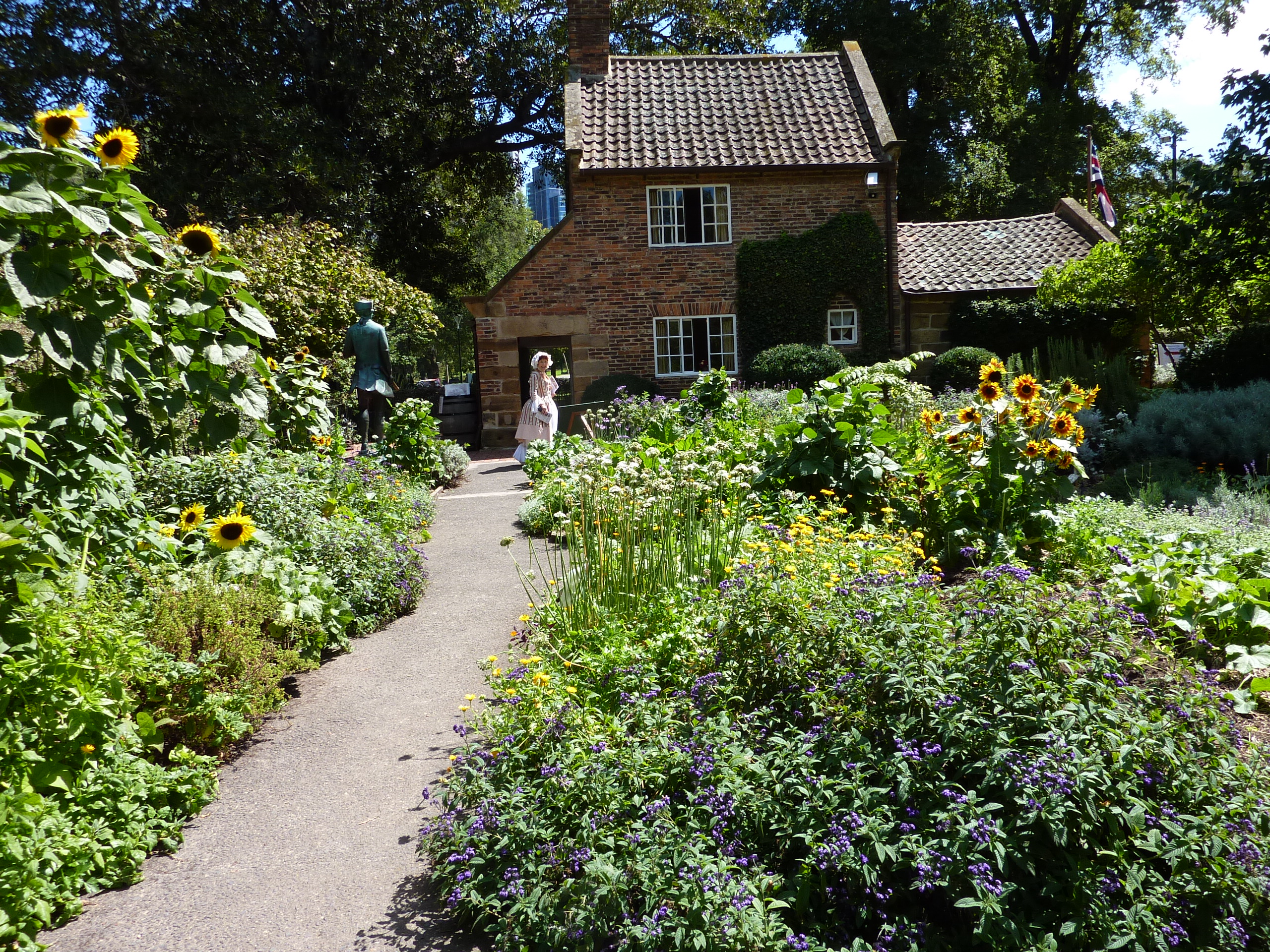
Fitzroy Gardens was a pleasant place to explore – a large area of formal parkland and gardens. We discovered a model Tudor Village, donated to the Citizens of Melbourne after the Second World War by the Citizens of Lambeth as a thank you for food donations made during and after the war. Citizens of Melbourne – you have been conned. This is not a model Tudor Village. It is a motley collection of gaudy house-shaped boxes, vaguely decorated in black and white, and scattered around a small enclosure. The adjacent Fairy Tree was more interesting – a tree carved by a famous local writer of children’s tales with characters from her books. She is so famous that I can’t remember her name.
On the way out of the gardens we spotted a rat. At least I said it was rat, but Chas thought it was a marsupial mouse, and so she filmed and photographed at some length.
From Fitzroy Gardens we walked to the next bus stop, and caught the bus to the Botanical Garden where we were due to meet Chris, Lucy and the girls for a picnic. We had arranged to meet at the entrance to the gardens. Chris assured us that there is only one entrance, whereas in fact, there are four entrances, and Chris wasn’t responding to phone calls. The bus dropped us off at the Observatory Gate, where we found a map, showing which entrance was the closest to Chris’s office, where he was meeting Lucy before walking to meet us. We had a pleasant walk to the other side of the gardens, and waited for the family at the entrance overlooking the River Yarra, until Chris called to say that they were at the Observatory entrance, and where were we? We eventually met in the middle of the gardens, and had a very nice picnic in the evening sunshine, beside a lake, with a backdrop of dramatic skyscrapers emerging from the trees.
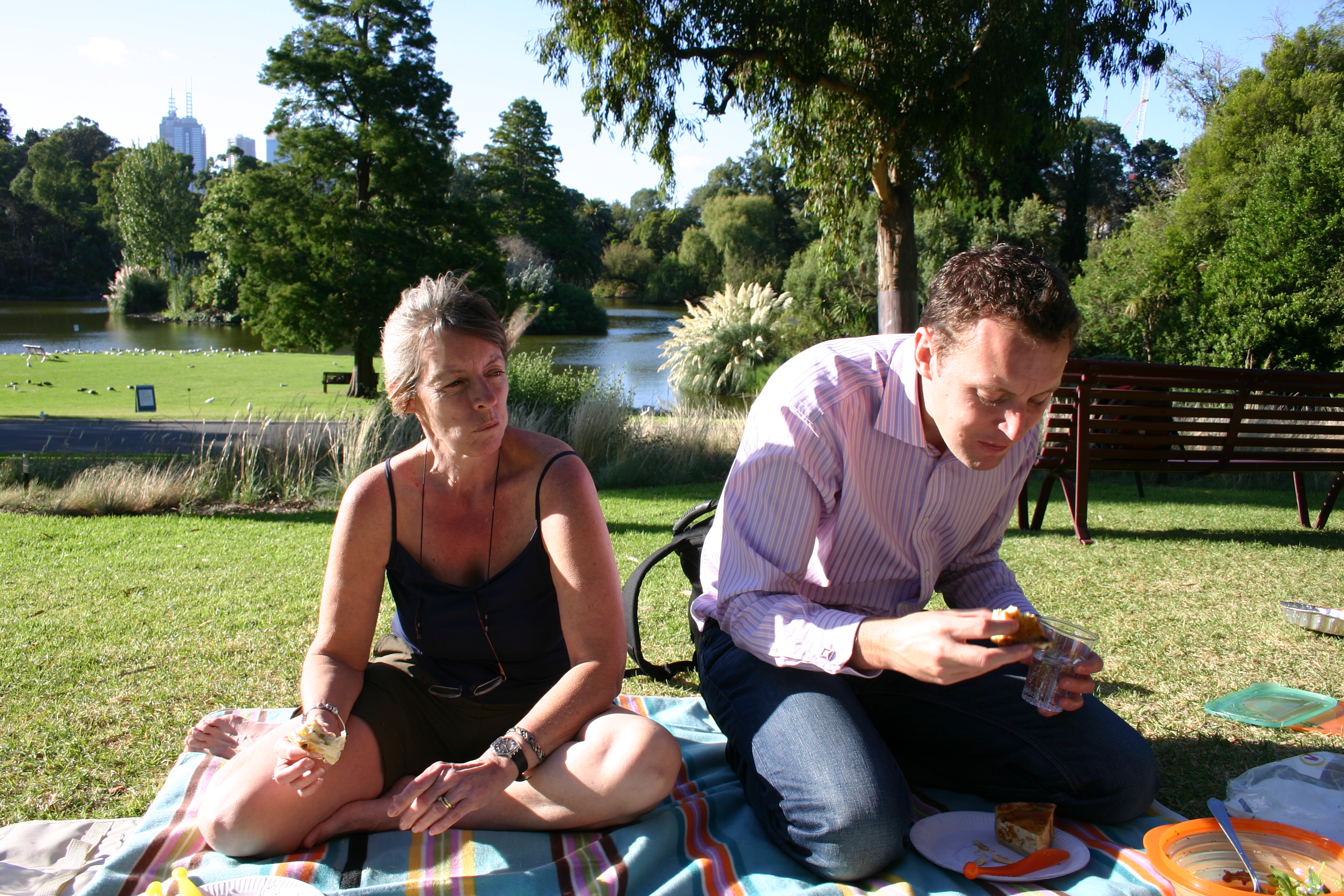
Between 5.30pm and 7.00pm, while we were picnicking, the gardens were very quiet. At about 7.00pm the gardens became alive with activity. It seems that every kind of outdoor (and some indoor) sport is practiced informally in the garden during the evening, and while walking to the cars we saw joggers, sprinters, hill runners, various ball games, gymnastics and some intriguing exercises that involved running very slowly up steps. There was even boxing exercises taking place in a bandstand, and rowers on the river. “The Tan” is a 3.8km track at the perimeter of the gardens, used for running, jogging, walking and cycling – this was very busy as we walked along it. There was a great atmosphere.
There was also a nice atmosphere as we walked along the bank of the River Yarra. The embankment is lined with restaurants and bars, and is used by cyclists, joggers, walkers and street entertainers. On the far side of the river, the evening sun was lighting up the highest floors of the modern office blocks, and lights were coming on throughout the business district. The music from the bars added to the atmosphere.
With just one day to explore, we didn’t really do Melbourne justice. Unlike Sydney, places of interest are spread around the City, and maybe we should have been more organised to make better use of the time that we had.
Day 6 – The seaside.
Chris and Lucy were at work all day, and went to a concert in the evening. We had the girls to ourselves all day. It was warm and sunny, and we had the use of Lucy’s people-carrier, and so we set off for Torquay, a seaside resort an hour or so from Melbourne. Torquay was much like any British small resort, but very much quieter. We had no trouble parking really close to the sea, and walked to where a grassy bank led directly down to the beach. There was a chilly sea breeze at first – I’ve known warmer days at Skegness. But the sun eventually emerged to warm things up significantly.
After a picnic on the grass, we applied sun cream to the girls and headed for the sea, which seemed only a little warmer than the sea at Skegness. We paddled, jumping the waves as is traditional, until Bridget fell over into the water, at which point everything got a bit noisy. We retired hurt back up the beach, where Bridget announced that beaches are for the weekends when Daddy is there, and we’ve got to go home now. We persuaded her to play in the sand for a while, until she and Grannie Chas decided to go and investigate the local lavatory arrangements, leaving Megan and me making sandcastles. Or at least one of us was happily making sandcastles, and one of us was happily demolishing them, but it was good fun. Eventually Bridget returned with Grannie Chas, and demanded to go and play in the sea – Grannie had taken her to a park to play on the swings, and she decided that this was quite a nice place after all.
I had been looking forward to re-living times spent with Simon and Matthew digging canals and tunnels. However is seemed that girls don’t do civil engineering, and we limited ourselves to simple sandcastles.
Before heading for home we had an ice cream. Bridget had an ice cream in a cup, and I had a large dollop of ice cream on a cone. Bridget held the cone for me while I lifted Megan onto a seat, and then having compared mine and her ice creams, she looked me in the eyes and said very seriously “We could swap ice creams, couldn’t we?” I declined the offer. There wasn’t a conveniently located hosepipe which would have been needed for Bridget-washing purposes.
We returned home for tea, story and bed (for the girls!), before Chas and I packed for an early trip to Sydney the following morning.
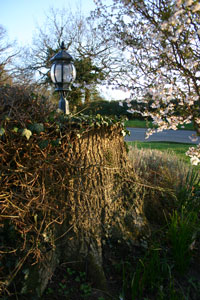 Technically we live in Oaktree House, but sadly the tree had to go.
We now have a thriving Oakstump at the front of the house.
Technically we live in Oaktree House, but sadly the tree had to go.
We now have a thriving Oakstump at the front of the house.